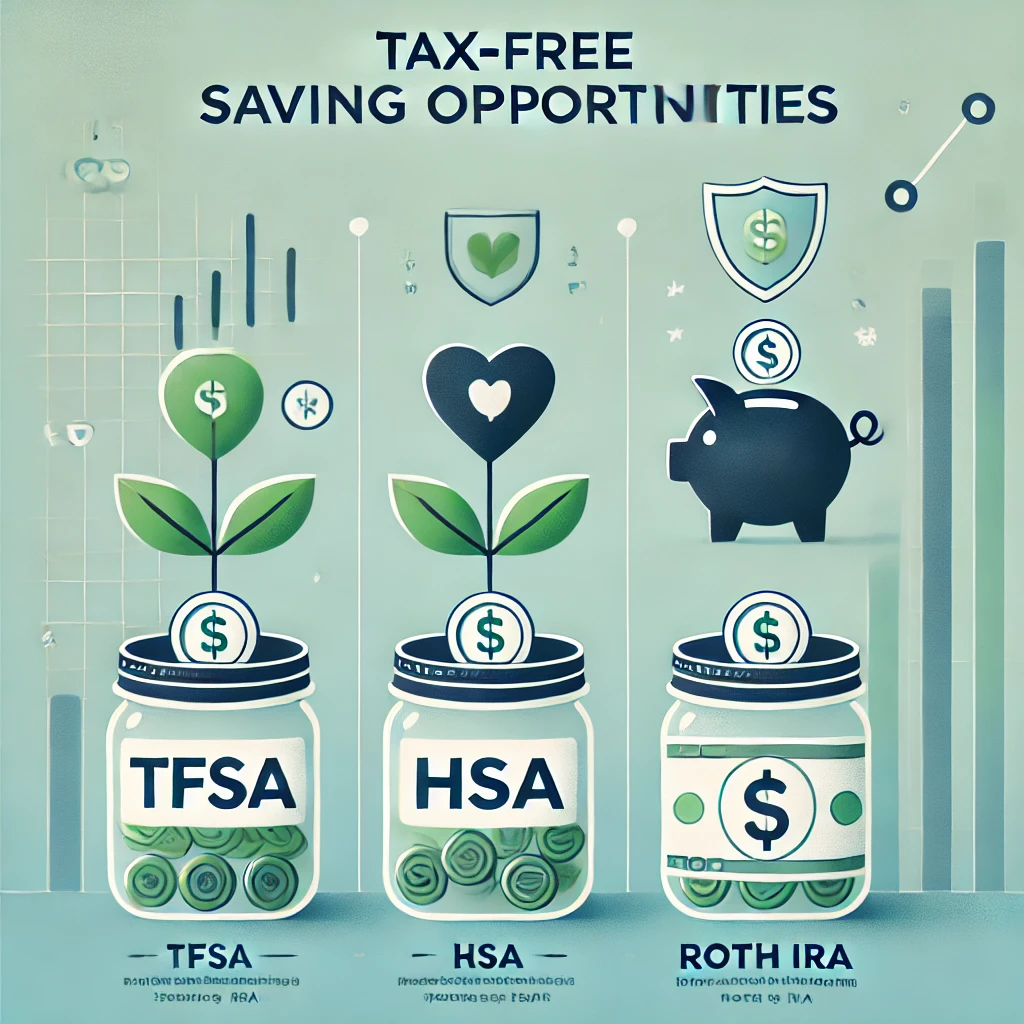
 alt="Roth IRA vs. TFSA vs. HSA" width="1024" height="1024" />
Roth IRA vs TFSA vs HSA For Americans and Canadians seeking tax-efficient savings strategies, three accounts stand out: the Roth IRA, Tax-Free Savings Account (TFSA), and Health Savings Account (HSA). Each offers unique tax benefits and growth opportunities for retirement, healthcare, and other financial goals—but they differ in contribution eligibility, limits, tax treatment, and cross-border implications. This article provides an in-depth comparison of these tax-free accounts and discusses additional options like RESP, RDSP, 529, and ABLE accounts (which are typically designed for others’ benefit and are taxed similarly to TFSAs and HSAs under the Canada-U.S. Tax Treaty).
1. Who Can Contribute to Roth IRAs, TFSAs, and HSAs?
Roth IRA
- Target Audience: Available exclusively to U.S. taxpayers with earned income.
- Income Restrictions: For 2025, single filers with a Modified Adjusted Gross Income (MAGI) above $150,000 (phasing out at $165,000) and married couples filing jointly with a MAGI over $236,000 (phasing out at $246,000) are ineligible for direct contributions.
- Workaround: High-income earners can still contribute via a “backdoor Roth IRA” strategy.
TFSA
- Target Audience: Canadian residents aged 18 or older with a valid Social Insurance Number (SIN).
- Accessibility: There are no income restrictions, making the TFSA accessible for Canadians across all income levels.
HSA
- Target Audience: Available to U.S. taxpayers enrolled in a high-deductible health plan (HDHP) that meets IRS criteria.
- Additional Note: There are no income limits for HSA eligibility. However, contributions must stop once an individual enrolls in Medicare (typically at age 65), and if delayed, watch for the six-month look-back period requiring cessation of contributions in advance.
2. Contribution Limits for Roth IRA vs TFSA vs HSA
Each account has its own annual contribution limit, with unique accumulation rules.
- Roth IRA: In 2025, the annual contribution limit for a Roth IRA is $7,000, or $8,000 for those aged 50 and older. Contributions cannot exceed the account holder’s earned income, and this limit is cumulative with any traditional IRA contributions. Annual contribution limits do not roll-over.
- TFSA: For 2025, the TFSA annual contribution limit is $7,000. Unused contribution room from previous years carries forward indefinitely, allowing Canadian residents who were eligible since the account’s inception in 2009 and have not contributed to accumulate a total of $102,000 as of 2025.
- HSA: The HSA contribution limits for 2025 are $4,300 for individuals and $8,550 for families. Individuals aged 55 and older can contribute an additional $1,000 as a “catch-up” contribution. Unlike TFSAs, HSA contributions do not carry forward, and the limits are reset each year.
3. Taxation of Investment Earnings for Roth IRA vs TFSA vs HSA
All three accounts Roth IRA vs TFSA vs HSA allow for tax-free growth, but the specifics of how investment earnings are treated vary.
- Roth IRA: Investment earnings within a Roth IRA grow tax-free, meaning any dividends, interest, and capital gains are not taxed if they remain in the account for the required period.
- TFSA: Like the Roth IRA, the TFSA allows for tax-free growth on investments, so any earnings from dividends, interest, or capital gains are not subject to Canadian tax while held within the TFSA.
- HSA: The HSA offers a “triple tax advantage” in the U.S., where contributions, growth, and qualified medical withdrawals are all tax-free. Investment earnings within an HSA grow tax-free as long as they are used for qualified medical expenses.
4. Taxation Upon Distribution for Roth IRA vs TFSA vs HSA
Each account – Roth IRA vs TFSA vs HSA has different rules regarding withdrawals, especially concerning taxes and penalties.
- Roth IRA: Contributions to a Roth IRA can be withdrawn tax-free at any time. However, earnings can only be withdrawn tax-free after the account holder reaches age 59½ and the account has been open for at least five years. Withdrawing earnings before these conditions are met may result in taxes and a 10% penalty unless exceptions (such as a first-time home purchase or qualified education expenses) apply.
- TFSA: Withdrawals from a TFSA are entirely tax-free, regardless of the account holder’s age or the purpose of the withdrawal. Additionally, any amount withdrawn is added back to the contribution room in the following year, making TFSAs highly flexible.
- HSA: Withdrawals from an HSA are tax-free if used for qualified medical expenses. Non-medical withdrawals before age 65 are taxed as income and incur a 20% penalty. After age 65, non-medical withdrawals are taxed as income, but the penalty is waived, effectively allowing the HSA to function similarly to a traditional IRA for retirement.
5. Cross-Border Tax Considerations for Roth IRA vs TFSA vs HSA
Cross-border taxpayers, especially those with ties to both the U.S. and Canada, need to understand how these accounts are treated under each country’s tax rules and the Canada-U.S. Tax Treaty.
- Roth IRA: Roth IRAs are recognized as tax-free retirement accounts under the Canada-U.S. Tax Treaty. U.S. citizens residing in Canada can maintain their Roth IRAs without Canadian tax on growth or distributions, but no new contributions should be made as they will not receive the same tax treatment. It’s best to avoid contributing to a Roth IRA after becoming a Canadian tax resident, as this can complicate tax reporting and impact treaty benefits.
- TFSA: The IRS does not recognize TFSAs as tax-free accounts, and they are not covered by the Canada-U.S. Tax Treaty. As a result, U.S. citizens residing in Canada with TFSAs are required to report income generated within the TFSA on their U.S. tax returns, which can lead to tax inefficiencies and additional tax preparation fees.
- HSA: HSAs are not covered by the Canada-U.S. Tax Treaty and are considered taxable by Canada if held by Canadian tax residents. For U.S. citizens living in Canada, HSAs retain their U.S. tax benefits but face Canadian tax reporting requirements, making them challenging for cross-border taxpayers to maintain. U.S. taxpayers moving to Canada do not need to close the account but they should use it as quickly as possible and carefully manage their HSAs to avoid tax complications.
Summary Comparison Table for
Roth IRA vs TFSA vs HSA
| Feature | Roth IRA | TFSA | HSA |
| Who Can Contribute | U.S. taxpayers with income limits | Canadian residents, age 18+ | U.S. taxpayers with HDHP |
| Contribution Limits (2023) | $7,000 ($8,000 if 50+) | $7,000 (cumulative up to $102,000) | $4,300 individual / $8,550 family |
| Taxation of Earnings | Tax-free within account | Tax-free within account | Tax-free within account |
| Tax-Free Withdrawals | Qualified retirement withdrawals | Any purpose, any time | Qualified medical expenses |
| Non-Qualified Withdrawals | Tax and penalty on earnings before 59½ | None | Taxed as income; 20% penalty if under 65 |
| Included in Canada-U.S. Tax Treaty | Yes | No | No |
Roth IRA vs TFSA vs HSA
each provide tax-efficient growth opportunities, but they serve different goals and are best suited to specific financial situations. Roth IRAs are excellent for Americans saving for retirement, TFSAs offer unmatched flexibility for Canadians, and HSAs are ideal for U.S. taxpayers focused on healthcare and retirement savings.
For cross-border individuals, understanding the tax treatment and eligibility of each account is crucial, as the Canada-U.S. Tax Treaty only covers Roth IRAs, leaving TFSAs and HSAs subject to additional reporting and potential taxation. Consulting a tax advisor with expertise in cross-border situations can help you navigate these complexities and make the most of these accounts for your unique needs.