DISCLAIMER
This article is for general educational purposes and does not constitute tax, legal, investment, or financial advice. Cross-border rules change and depend on your specific facts and residency. All figures are stated for the tax year noted and were current as of publication. Confirm your situation with a qualified cross-border advisor before acting. 49th Parallel Wealth Management is a fee-only fiduciary; we do not sell products or earn commissions.
Toronto Cross-Border Financial Planning: The Complete Guide for High-Net-Worth Families Moving to the U.S.
By Lucas Wennersten, CFP® (US & Canada), CFA · 16-minute read
Part of The Toronto Cross-Border Series — cross-border wealth guidance for Toronto families building a life across the 49th parallel.
The email came in on a Tuesday in February. A managing director on Bay Street — call her Priya — had just accepted a role at her firm’s New York desk. Her husband could work remotely. Two kids, ages nine and twelve. A house in Leaside that had roughly quadrupled since they bought it. An RRSP each, two TFSAs, a professional corporation her husband used for his consulting income, and a modest chalet near Collingwood. “We’re excited,” she wrote. “But every advisor tells us something different, and one of them mentioned something called departure tax. Should we be worried?”
If you are a high-net-worth family in Toronto contemplating a move to the United States, you have probably had a version of Priya’s Tuesday. The move itself is the easy part. What surprises most Toronto families is how much of their financial life quietly changes the moment they stop being Canadian tax residents — and how many of the most expensive mistakes are made in the months before anyone has boarded a plane.
This guide is the map. It walks through every major decision a Toronto family faces when crossing the border: the departure tax, the private corporation problem, your registered accounts, U.S. estate tax, the family home, where Torontonians actually land, and the mistakes that cost the most. Each section links to a deeper article in this series. Think of this page as the table of contents for the whole move.
Who This Guide Is For
Toronto generates more high-net-worth cross-border moves to the United States than any other Canadian city, and the wealth here is unusually varied. You might be a Bay Street banker or portfolio manager taking a U.S. role; a tech founder after an exit; a real estate developer with U.S. holdings; a physician or dentist with an incorporated practice; or the second or third generation of a family that has been quietly wealthy for decades. What these families share is complexity: appreciated real estate, equity compensation, private corporations, and registered portfolios that have compounded for years.
That complexity is exactly why generic “moving abroad” advice fails Toronto families. A person with a salary and a chequing account can move to Florida with a few forms. A family with a holdco, RSUs vesting across the move date, and a $3-million principal residence is making eight or nine interlocking decisions at once — and the Canadian and U.S. tax systems do not coordinate them for you. Getting the sequence right is worth far more than getting any single piece perfect.
This is our home ground. 49th Parallel is a fee-only, fiduciary firm, dual-licensed in the U.S. and Canada, and I’ve lived the cross-border life myself from our base in Scottsdale, Arizona. When we talk about cross-border financial planning for Toronto families, we’re describing work we do every week.
What Actually Changes the Day You Become a U.S. Resident
Canada taxes based on residency; the United States taxes its citizens and residents on worldwide income no matter where they live. The pivot point of your entire move is the date you cease Canadian tax residency and the date you become a U.S. resident — and those two dates, and everything you do around them, drive the tax outcome.
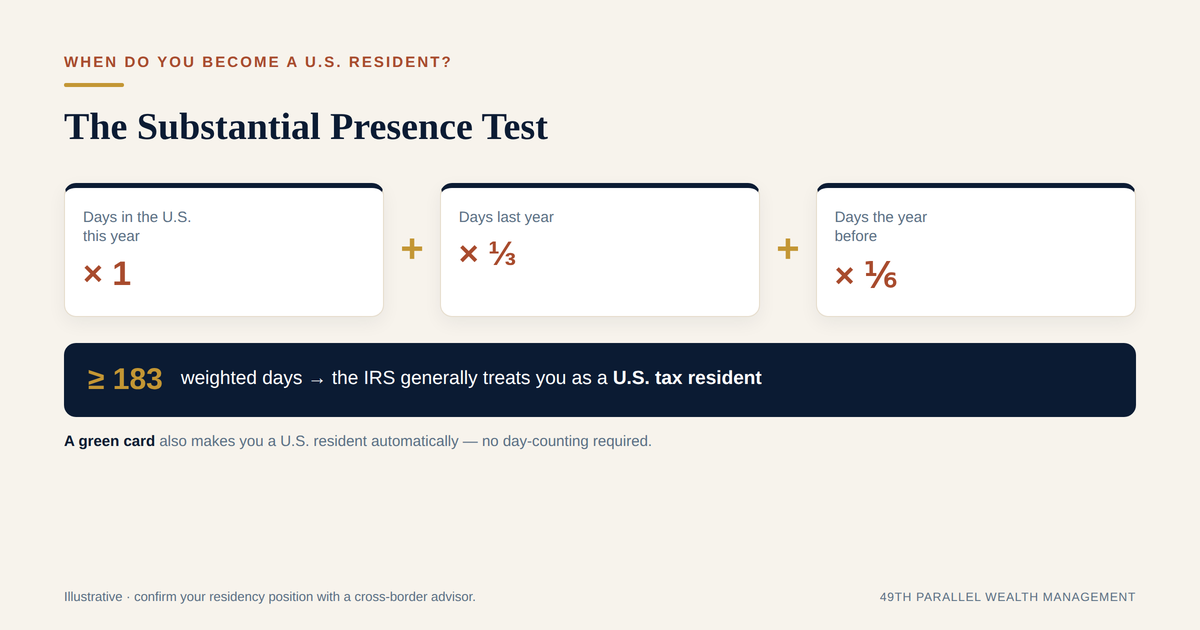
On the U.S. side, residency for tax purposes usually turns on either a green card or the Substantial Presence Test, a day-counting formula that adds all of your days this year, one-third of last year’s, and one-sixth of the year before. Cross 183 weighted days and the IRS generally treats you as a resident. Snowbirds who have spent years just under the line are often startled to learn how the weighting works.
On the Canadian side, ceasing residency triggers a one-time event that catches many families off guard: the departure tax. It’s the single most important concept in this guide, so it goes first.
 alt="When do you become a U.S. Resident- The Substantial Presence Test" width="1200" height="630" />
- Departure Tax — The Deemed Disposition
When you emigrate from Canada, the Canada Revenue Agency treats you as if you sold most of your property at fair market value on the day you leave, and taxes the resulting gain. Nothing is actually sold — but the tax is real. This “deemed disposition” is why Priya’s advisor told her to worry.
Not everything is caught. Canadian real estate, RRSPs and RRIFs, TFSAs, and registered pension plans are generally excluded from the deemed disposition. What is caught is the part of a Toronto family’s balance sheet that has usually grown the most: non-registered investment portfolios, shares of private corporations, and many other capital assets. For a family with a large taxable portfolio or a valuable holdco, the departure-tax bill can run well into six or seven figures.
The Canadian capital gains inclusion rate remained at 50% for 2025 — the previously proposed increase to two-thirds was cancelled by the federal government — so half of a deemed gain is taxable at your Ontario marginal rate in your year of departure. Timing therefore matters enormously: the year you leave, your province of residence, and whether you can trigger or defer gains around the move date can swing the result materially. CRA also allows you to elect to defer payment of departure tax (typically by posting security) rather than paying it all in the year you leave.
KEY NUMBERS (2025)
- Capital gains inclusion rate: 50% (the proposed two-thirds increase was cancelled).
- Lifetime Capital Gains Exemption: CA$1,250,000 on qualifying small-business-corporation shares.
- Departure tax applies to a deemed disposition of most non-registered capital property; Canadian real estate, RRSP/RRIF, and TFSA are generally excluded.
 alt="Leaving Canada- Separture Tax: What's Deemed Sold" width="1200" height="630" />
Toronto’s corporate-heavy wealth makes this the highest-stakes section of the move. We go deep on the mechanics — the pre-departure planning window, the LCGE, and estate-freeze timing — in Departure Tax for Toronto Business Owners: What the CRA Takes When You Leave.
- Your Private Corporation Becomes a U.S. Tax Problem
If you own a Canadian private corporation — an incorporated practice, a consulting company, a holdco — the move changes how it is taxed, and not in your favour. Once you are a U.S. person, a corporation you control can become a Controlled Foreign Corporation in the eyes of the IRS. That drags in the U.S. anti-deferral regime: Subpart F income and GILTI can tax you currently in the U.S. on the corporation’s earnings, even if you never take a dividend.
The mismatch between the two systems is the real trap. Strategies that are perfectly efficient in Canada — retaining investment income inside a holdco, paying yourself dividends over time — can create ugly U.S. outcomes, including exposure to the punitive Passive Foreign Investment Company rules if the corporation holds the wrong kind of assets. The planning window is before you become a U.S. person: purifying the company, paying out retained earnings, restructuring, or in some cases winding up may all be on the table.
We cover the corporate structure question — CFC status, Subpart F, GILTI, and the timing windows — in the Toronto business-owner articles in this series, and it is core to our cross-border tax planning work.
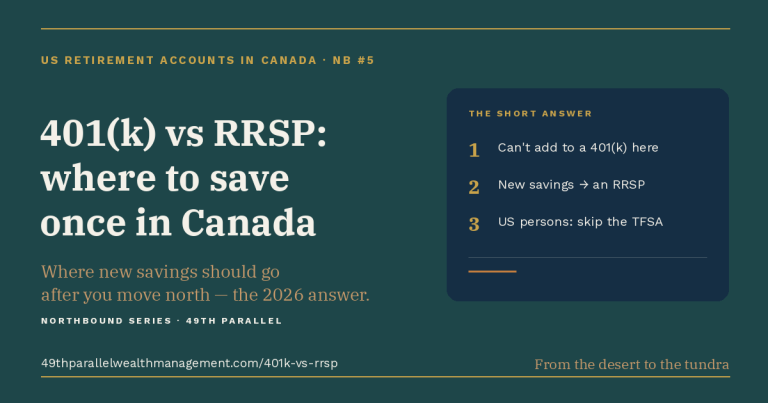
- RRSPs, TFSAs, RESPs, and Your Public Pensions
Your registered accounts each behave differently across the border, and the differences are large enough to reshape your withdrawal strategy for decades.
 alt="Your Registered Accounts- RRSp vs TFSA, Across the Border" width="1200" height="630" />
RRSP and RRIF — the good news
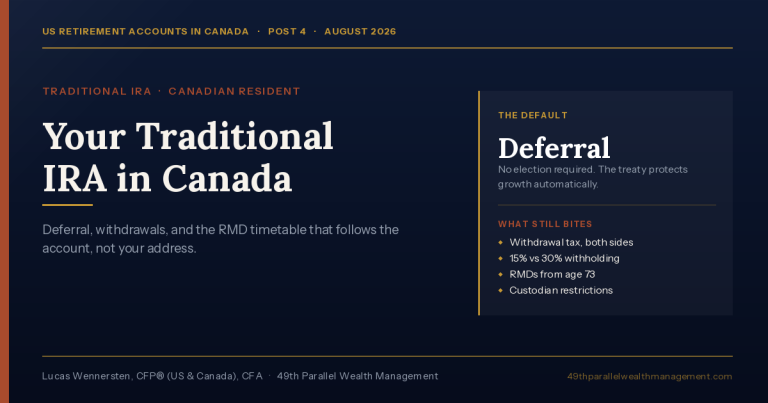
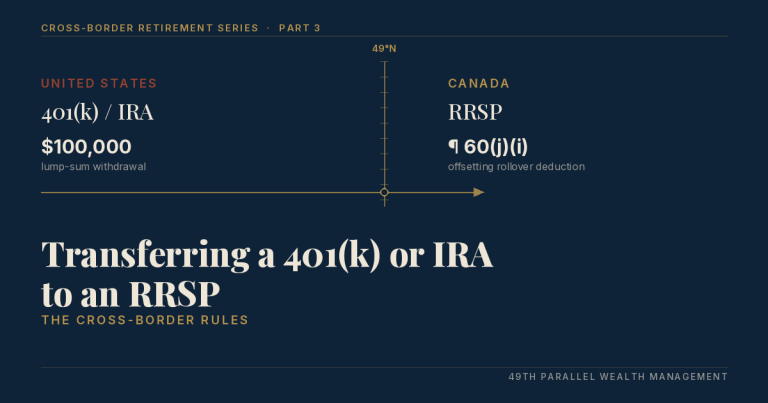
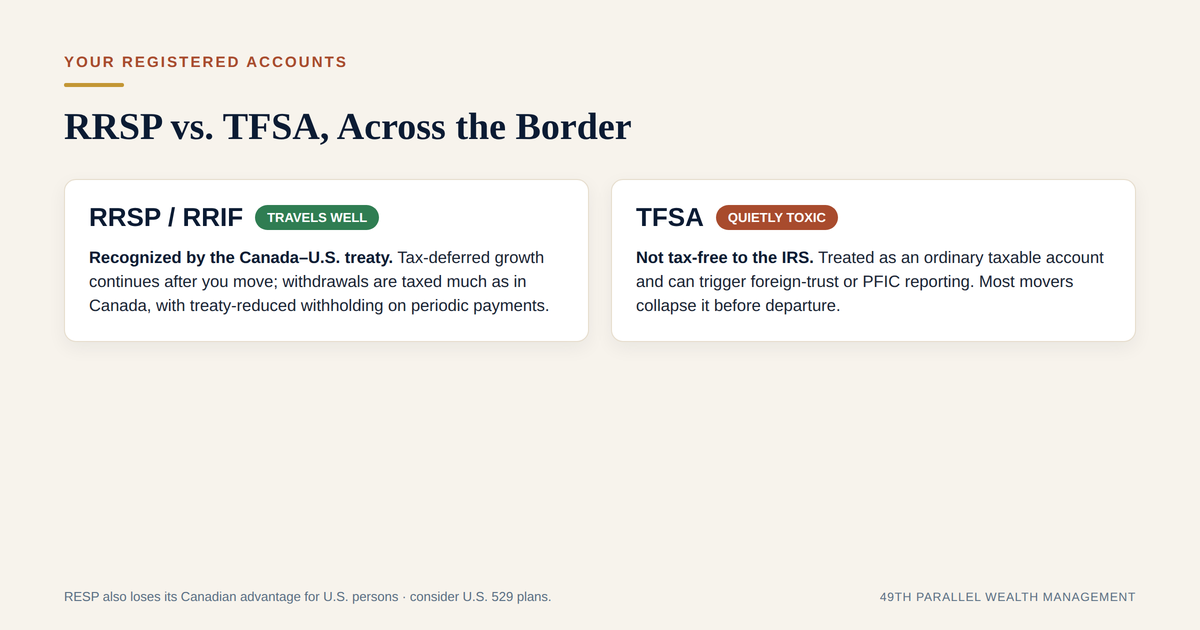
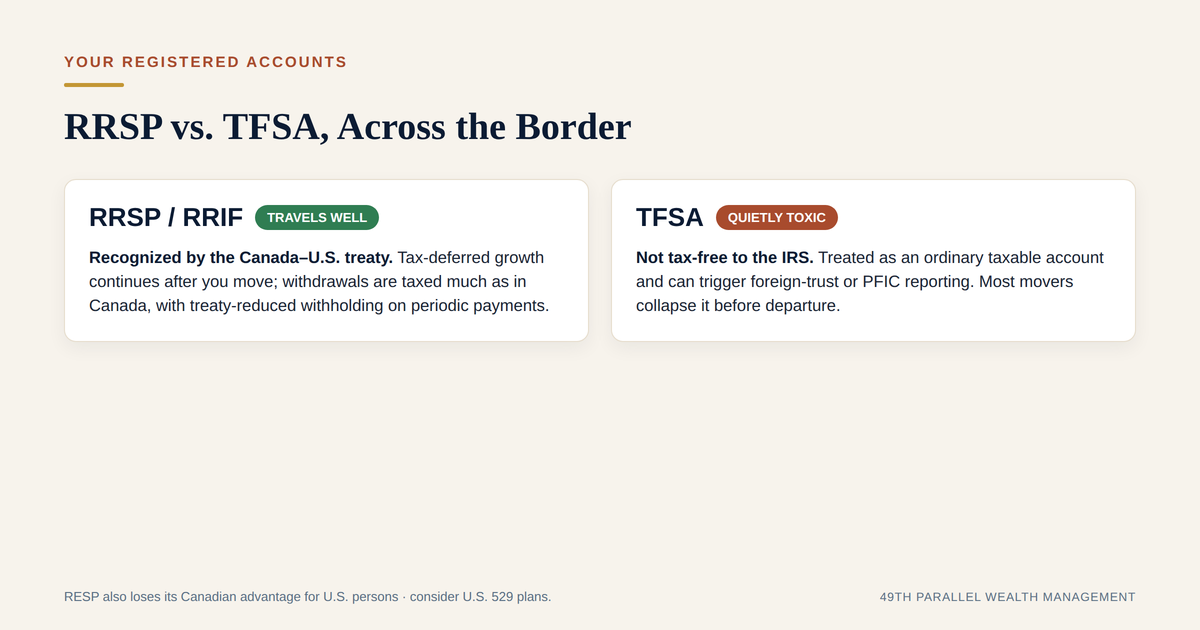
The Canada-U.S. tax treaty recognizes your RRSP and RRIF as retirement accounts, so you generally keep tax-deferred growth after you move, and the U.S. taxes withdrawals much as Canada does. Canada applies a non-resident withholding tax on withdrawals (reduced under the treaty for periodic pension payments). For many Toronto families there is a genuine planning opportunity in the low-income years right after a move to draw down RRSPs at favourable combined rates.
TFSA — quietly toxic once you’re a U.S. person
The United States does not recognize the TFSA as tax-free. To the IRS it is just a taxable account, and depending on what it holds it can trigger onerous foreign-trust or PFIC reporting. A TFSA that saved you tax in Canada can cost you tax and filing headaches in the U.S. For most movers, the question is whether to collapse the TFSA before departure.
RESP — no longer tax-advantaged in the U.S.
Like the TFSA, the RESP loses its tax-favoured status once you are a U.S. resident and can create reporting obligations. Families with education savings need a plan for the RESP and a view on U.S. 529 plans.
CPP, OAS, and U.S. Social Security
Public pensions are coordinated by treaty. Under Article XVIII of the Canada-U.S. tax convention, CPP and OAS paid to a U.S. resident are taxable only in the United States (with a portion exempt), and U.S. Social Security paid to a Canadian resident is taxable only in Canada. The Canada-U.S. totalization agreement also lets you combine work credits from both countries to qualify for benefits.
CONTRIBUTION LIMITS (for reference)
- RRSP dollar limit: CA$32,490 (2025); CA$33,810 (2026).
- TFSA annual limit: CA$7,000 (2025) — but see the warning above for U.S. persons.
The full drawdown-and-coordination strategy is in RRSP, TFSA, and CPP: What Toronto Professionals Need to Know Before Moving to the U.S., and it anchors our cross-border retirement planning.
- U.S. Estate Tax and Cross-Border Estate Planning
Here is the surprise that catches Toronto families with U.S. property or investments: the United States levies estate tax on the worldwide estate of its citizens and residents, and on the U.S.-situated assets of everyone else. Canada has no estate tax — we tax gains at death instead — so the U.S. estate tax is an unfamiliar and potentially very large exposure.
The good news for most families: the U.S. estate and gift exemption is US$15 million per individual for 2026, up from US$13.99 million in 2025, after the Working Families Tax Cuts legislation signed in July 2025 made a high exemption permanent. A married couple can shelter roughly double that. The annual gift-tax exclusion is US$19,000 per recipient (2025 and 2026).
The trap is for Canadians who are not U.S. citizens or residents but own U.S.-situs assets — a Florida condo, an Arizona golf home, U.S. stocks in a brokerage account. Their bare U.S. exemption is only US$60,000. Fortunately, the Canada-U.S. treaty provides a pro-rated share of the full unified credit, which usually eliminates the tax for all but the largest estates — but only if you plan and file correctly. Beyond estate tax, cross-border families typically need a two-will structure and careful beneficiary designations so that Ontario estate law and U.S. state law don’t work against each other.
The full treatment — two wills, the U.S. revocable-trust trap, RRSP successor designations, and estate tax on vacation property — is in Estate Planning for Toronto HNW Families Moving to the U.S., the heart of our cross-border estate planning.
- Your Toronto Home and the Chalet
For most Toronto families the home is the largest single asset, and the principal residence exemption is one of the most valuable shelters in Canadian tax. Whether you sell before you leave, keep the house as a rental, or hold the cottage changes both the Canadian and U.S. tax picture. Selling while still a Canadian resident generally preserves the principal residence exemption; keeping and later selling as a non-resident introduces Canadian withholding and compliance steps. A second property like the Collingwood chalet does not get the same exemption and can carry a real deemed-disposition cost on departure.
On the U.S. side, when you eventually buy — or if you sell U.S. property as a Canadian — the FIRPTA regime applies a 15% withholding on the gross sale price of U.S. real estate sold by a foreign person, refundable against the actual tax but a genuine cash-flow event. Financing a U.S. home as a newcomer with no U.S. credit history is its own project.
We map the sell-or-hold decision and the timing in Selling Your Toronto Home Before Moving to the U.S.: Tax and Timing Strategy.
- Where Toronto Families Actually Land
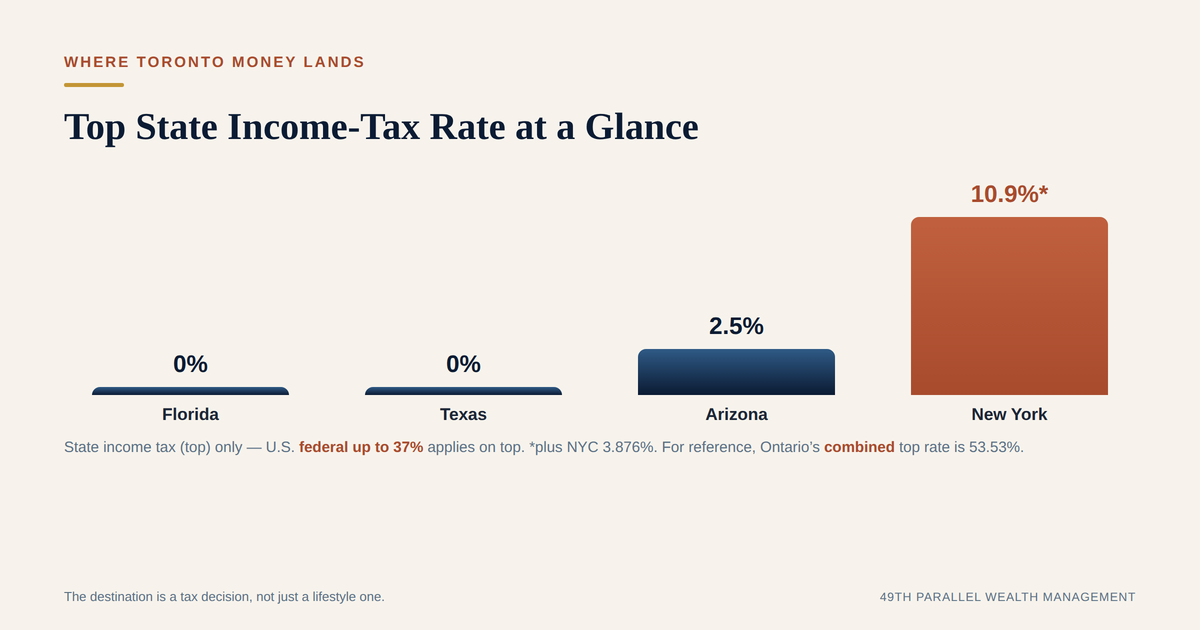
Toronto’s cross-border moves cluster in a few places, each with a different financial logic. Miami and South Florida draw finance professionals and lifestyle movers with no state income tax and a strong homestead regime. Dallas and Houston attract families chasing lower taxes and business opportunity, also with no state income tax. Phoenix and Scottsdale — our own backyard — pull retirement-adjacent families, golfers, and the growing cohort turning a winter second home into a permanent one. New York remains the natural landing spot for Bay Street careers, at the cost of one of the highest combined tax burdens in the country.
The destination is not just a lifestyle choice; it is a tax decision. A move to Florida or Texas versus New York or California can change your lifetime tax bill by a life-changing amount, and it interacts with where you hold property and how you draw income.
 alt="Top State Income-Tax Rate at a Glance" width="1200" height="630" />
Two articles in this series go deep here: our Florida guide, Moving from Toronto to Miami: A Financial and Lifestyle Guide, and the candid lifestyle piece, What Toronto Expats Actually Say About Life in Miami, Dallas, and Scottsdale.
- Your Kids, Their Citizenship, and Education
The reason you are crossing the border is almost always the family, and children add their own layer of cross-border planning. Kids born in Canada to a move may acquire or already hold dual citizenship, which carries lifelong U.S. tax and filing consequences most parents don’t anticipate. Education savings need a decision — the RESP loses its Canadian advantages, while U.S. 529 plans open up — and questions of schooling, custody arrangements, and support across borders deserve early attention.
We wrote Raising Cross-Border Kids: Education and Family Planning for Toronto Families Moving to the U.S. for exactly this.
- The Mistakes That Cost the Most
After enough of these moves you see the same avoidable errors repeat. Leaving a TFSA open after becoming a U.S. person. Cashing an RRSP prematurely and eating an unnecessary withholding hit. Failing to plan the departure-tax year. Walking into the PFIC trap by holding Canadian mutual funds or ETFs as a U.S. person. Moving without a U.S.-situs will. Each of these is preventable with a few months of runway and the right sequence.
We collected them in 7 Cross-Border Financial Mistakes Toronto Professionals Make (And How to Avoid Them).
- The 12-Month Runway
Almost everything in this guide is easier and cheaper if you start early. The best cross-border moves begin roughly a year out: reviewing the corporate structure, deciding the fate of the TFSA and RESP, planning the departure-tax year, updating wills, and lining up U.S. banking and credit before you need them. The worst moves happen when a family calls us the week before the flight. A structured checklist turns an overwhelming list into a month-by-month plan.
Our printable planner, Toronto to the U.S.: Your 12-Month Pre-Move Financial Checklist, is the companion to this guide.
How We Work With Toronto Families
At 49th Parallel, we work with families — not portfolios. Cross-border planning is technical, but the reason you’re crossing that border is your family, your career, your next chapter. We bring the dual-licensed expertise to get the technical details right, and the fiduciary commitment — fee-only, no products, no commissions — to make sure the advice serves you. I’ve made this crossing myself, and I advise from Scottsdale, where a good number of Toronto families eventually land.
If you’re starting to think about a move, the best first step is a conversation. You can book a complimentary consultation and we’ll map your specific situation together.
Frequently Asked Questions
What is Toronto cross-border financial planning?
It’s the coordinated tax, investment, retirement, and estate planning a high-net-worth Toronto family needs when moving between Ontario and the United States. Because Canada and the U.S. tax systems don’t align, it focuses on sequencing decisions — departure tax, corporations, registered accounts, and estate structure — around your change of residency.
What is departure tax when leaving Toronto for the U.S.?
When you cease Canadian residency, the CRA treats you as having sold most of your non-registered capital property at fair market value and taxes the resulting gain. Canadian real estate, RRSPs/RRIFs, and TFSAs are generally excluded. For 2025 the capital gains inclusion rate is 50%, and you can elect to defer payment by posting security.
Do I have to close my TFSA if I move to the United States?
Not legally, but for most movers it makes sense. The U.S. doesn’t recognize the TFSA as tax-free — it’s a taxable account to the IRS and can trigger foreign-trust or PFIC reporting. Many Toronto families collapse the TFSA before departure to avoid ongoing U.S. tax and filing costs.
What happens to my RRSP when I move to the U.S.?
The Canada-U.S. tax treaty recognizes RRSPs and RRIFs, so you keep tax-deferred growth and the U.S. taxes withdrawals similarly to Canada. Canada applies a non-resident withholding tax on withdrawals, reduced under the treaty for periodic pension payments. The low-income years right after a move can be a good window to draw down at favourable rates.
Will I owe U.S. estate tax as a Canadian?
The U.S. estate and gift exemption is US$15 million per person for 2026 (US$13.99 million in 2025), so most families are under it. Canadians who aren’t U.S. persons but own U.S.-situs assets have only a US$60,000 bare exemption, but the Canada-U.S. treaty provides a pro-rated unified credit that usually eliminates the tax — with proper planning and filing.
How does the CRA decide I’ve stopped being a tax resident?
It’s based on residential ties — home, spouse and dependants, and secondary ties like bank accounts, cars, and memberships. Severing primary ties on a clear date is what establishes your departure. Because the date drives the departure-tax calculation, it should be planned, not accidental.
Should I sell my Toronto home before I leave?
It depends. Selling while still a Canadian resident generally preserves the principal residence exemption. Keeping the home and selling later as a non-resident introduces Canadian withholding and extra compliance. A second property like a cottage doesn’t get the exemption and can carry a deemed-disposition cost on departure.
How far in advance should I start planning a Toronto-to-U.S. move?
Ideally about 12 months. That runway lets you address the corporate structure, decide the fate of the TFSA and RESP, plan the departure-tax year, update wills, and set up U.S. banking and credit before you need them. The most expensive mistakes happen in last-minute moves.
More from The Toronto Cross-Border Series
- Why Toronto’s Wealthiest Families Are Moving to the U.S. (And What They’re Leaving Behind)
- Departure Tax for Toronto Business Owners: What the CRA Takes When You Leave
- Bay Street to Wall Street: Cross-Border Planning for Toronto Finance Professionals
- Estate Planning for Toronto HNW Families Moving to the U.S.
- RRSP, TFSA, and CPP: What Toronto Professionals Need to Know Before Moving to the U.S.
- Moving from Toronto to Miami: A Financial and Lifestyle Guide
- Raising Cross-Border Kids: Education and Family Planning for Toronto Families
- Selling Your Toronto Home Before Moving to the U.S.: Tax and Timing Strategy
- What Toronto Expats Actually Say About Life in Miami, Dallas, and Scottsdale
- 7 Cross-Border Financial Mistakes Toronto Professionals Make (And How to Avoid Them)
- Toronto to the U.S.: Your 12-Month Pre-Move Financial Checklist
Ready to Map Your Move?
Every Toronto family’s crossing is different, but the sequence matters more than any single decision. If you’re weighing a move to the U.S., let’s talk before the big choices get locked in.
→ Book a complimentary consultation · Lucas Wennersten, CFP® (US & Canada), CFA · Scottsdale, Arizona