Cross-Border Real Estate: A Canadian–US Property Investment Guide
By Lucas Wennersten, CFP® (US & Canada), CFA · 10 minute read · Updated May 14, 2026
Real estate is one of the most common cross-border assets a Canadian or American family will ever own. A Canadian snowbird with a winter home in Arizona, an American moving to Toronto for work who buys a condo, a Canadian family inheriting US property — all face cross-border tax rules that look nothing like the rules in their home country.
The two directions are not symmetrical. The US uses FIRPTA — the Foreign Investment in Real Property Tax Act — to withhold tax from non-resident sellers of US property. Canada uses its own non-resident withholding regime, different rates, and a separate elective system called Section 216 for rental income. Get either direction wrong and the costs show up at closing, at tax time, or both.
This guide walks through both directions: what happens when a Canadian buys US real estate, what happens when an American buys Canadian real estate, and the tax filing and withholding rules that apply in each case. By the end, you’ll know which forms you need, which rates apply, which elections to make, and the most common mistakes to avoid.
Why Cross-Border Real Estate Is Different
When you buy real estate in your home country, the tax treatment is contained: a single tax authority, one filing system, one set of rules. Cross-border real estate breaks that simplicity in three ways.
First, both countries tax non-residents on real property located in their territory. The US taxes Canadian owners on US rental income and capital gains. Canada taxes American owners on Canadian rental income and capital gains. There is no way to opt out of the country where the property sits.
Second, the tax treaties don’t eliminate this — they just allocate the taxing right and provide a credit mechanism. The Canada-US Tax Convention gives the country where the property is located the primary right to tax. Your home country still requires you to report the income, but you generally get a foreign tax credit for the tax paid abroad.
Third, the withholding regimes in both countries treat non-residents as flight risks. Both the US and Canada require that buyers withhold a percentage of the sale price at closing — not the gain, the gross sale price — to ensure the tax owed actually gets paid. This is where most cross-border real estate problems start.
Direction 1: Canadians Buying US Property
Canadians own US real estate for three main reasons: snowbird residences in Florida, Arizona, or California; rental investment properties in major US metros; and family vacation homes inherited or purchased over time. All three trigger the same set of US tax rules.
At Purchase
Buying US property as a Canadian is administratively simple. You can take title in your own name, through a US LLC, or through a Canadian corporation (the last option is usually a mistake — it creates double taxation). Most Canadian buyers take title individually or through a joint tenancy with their spouse.
Two practical steps to take at purchase:
First, apply for an Individual Taxpayer Identification Number (ITIN) from the IRS. You’ll need this to file US tax returns and to apply for any withholding-certificate relief at sale. Filing Form W-7 takes 7 to 11 weeks, so apply early.
Second, set up a US bank account if possible. Cross-border banking through your Canadian institution (RBC, TD, BMO all have US arms) is the easiest path. This simplifies property tax payments, utilities, and rental income deposits.
If You Rent It Out
Rental income from US real estate is taxed two ways depending on how you elect:
Default (no election): The IRS treats your rental income as fixed, determinable, annual, or periodical (FDAP) income. Your tenant (or property manager) withholds 30% of the gross rent and remits it to the IRS. You can deduct nothing — no mortgage interest, no property tax, no maintenance. This is almost always the wrong approach.
Net election (the right approach): File Form 1040-NR with an attached statement electing to treat the rental as ‘effectively connected with a US trade or business’ under IRC §871(d). This lets you deduct mortgage interest, property tax, depreciation, insurance, repairs, and management fees, then pay tax on the net income at regular rates. Most Canadian rental owners end up with little or no US tax owed under this election because depreciation alone often offsets the income.
You’ll also need to file Schedule E with Form 1040-NR each year. Even in years with zero income (vacant property), the return should be filed to maintain the election.
When You Sell — FIRPTA Withholding
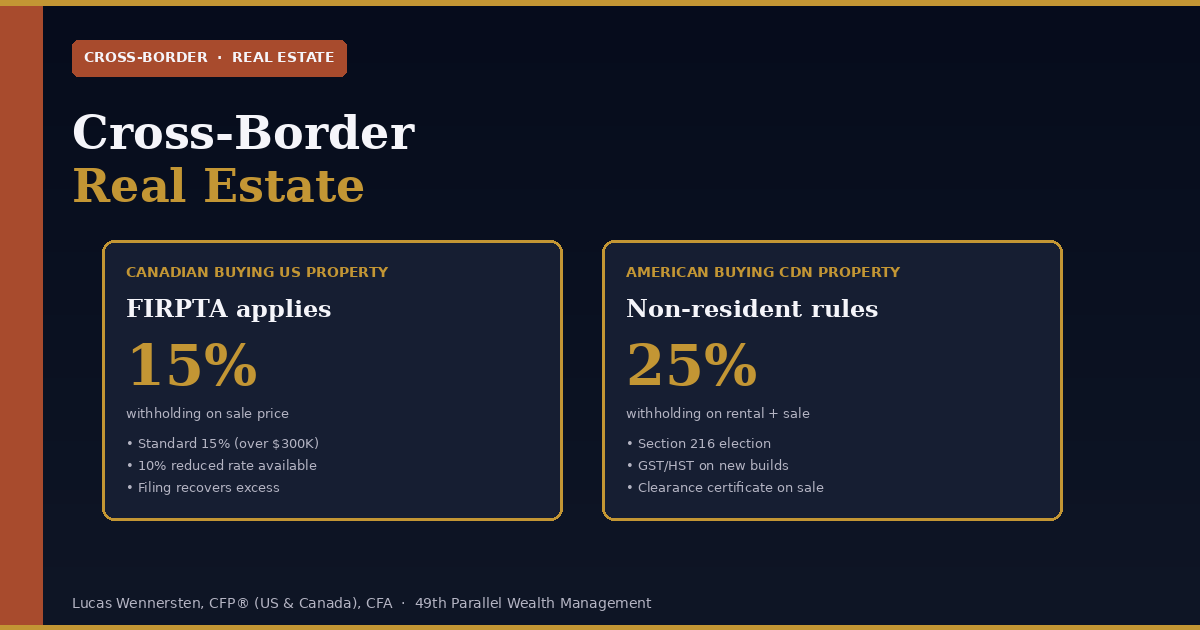
This is the rule that surprises most Canadian sellers. Under the Foreign Investment in Real Property Tax Act (FIRPTA), the buyer is required to withhold a percentage of the GROSS SALE PRICE — not the gain, the sale price — at closing and remit it to the IRS. The rates are:
- Standard 15%: Sale price exceeds $300,000 and no exemption applies.
- Reduced 10%: Sale price is between $300,001 and $1,000,000 AND the buyer will use the property as their principal residence.
- Exempt (0%): Sale price is $300,000 or less AND the buyer signs an affidavit that they will use the property as their principal residence.
The withholding is an estimate of US tax owed. After closing, you file Form 1040-NR for the year of sale, compute the actual capital gain tax, and either pay any shortfall or claim a refund for the excess withheld. Most sellers get a refund — the 15% gross withholding is almost always more than the actual capital gains tax owed.
If you anticipate the actual tax will be much lower than the withholding, you can file Form 8288-B before closing to apply for a withholding certificate that reduces or eliminates the FIRPTA withholding. This requires filing 90+ days before closing — plan ahead.
Canadian Side: Reporting and the Foreign Tax Credit
If your US property’s cost exceeds $100,000 CAD at any point during the year, you must file CRA Form T1135 with your Canadian return — this is the Foreign Income Verification Statement. Failure to file is a $2,500 penalty per year, and CRA has actively assessed penalties for this since 2015. The threshold is based on cost, not market value.
Rental income from US real estate is reported on your Canadian T1 each year. You’ll claim a foreign tax credit for any US tax paid, and the gross-up/credit mechanic generally ensures you don’t pay tax twice on the same income.
On sale, Canada taxes the capital gain (50% inclusion rate after the June 2024 changes, or 66.67% for gains above $250,000 in a year). The foreign tax credit for the US tax paid reduces your Canadian tax bill but does not always eliminate it — the US capital gains tax is often lower than the Canadian tax on the same gain, leaving a Canadian top-up.
Direction 2: Americans Buying Canadian Property
Americans buy Canadian property less often than Canadians buy American property, but the cases are still common: Americans relocating to Canada for work, US-citizen retirees marrying a Canadian, cross-border family inheritances, and US investors buying recreational property in BC, Ontario, or Quebec. The rules are different — and in some ways more punitive — than the US side.
At Purchase
Americans can purchase Canadian real estate in most provinces, but several restrictions apply:
Foreign Buyer Ban: Canada’s federal Prohibition on the Purchase of Residential Property by Non-Canadians Act has been extended through January 1, 2027. The ban applies to most residential purchases by non-Canadian individuals, with exceptions for international students meeting certain conditions, permanent residents, and properties in less-populated areas. Confirm eligibility before signing a purchase agreement.
Provincial Foreign Buyer Tax: British Columbia’s Foreign Buyer Tax is 20% of the property value in the Greater Vancouver, Capital, Fraser Valley, and several other regions. Ontario’s Non-Resident Speculation Tax is 25% on residential property purchased by foreign nationals, anywhere in the province. These taxes are paid at closing on top of the purchase price.
GST/HST on new builds: New construction is subject to federal GST (or HST in harmonized provinces). Resale homes are generally exempt.
Land Transfer Tax: Both provincial and (in some cases) municipal transfer taxes apply. Toronto’s combined provincial + municipal land transfer tax can exceed 4% of the purchase price.
If You Rent It Out
Canadian rental income earned by a US-resident owner is subject to 25% Part XIII withholding on GROSS rent — paid by the tenant or property manager directly to CRA each month. This is high. The fix is the Section 216 election.
Section 216 Election: Under Section 216 of the Canadian Income Tax Act, a non-resident can elect to be taxed on NET rental income at regular Canadian tax rates instead of 25% on gross. You file a Section 216 return (Form T1159) by June 30 of the following year. To use this election, you need to file Form NR6 with CRA in advance (by January 1 of the year, or before the first rent payment) authorizing the tenant or property manager to withhold based on estimated net income rather than gross rent. Without NR6 filed, the 25% gross withholding continues to apply through the year — you only get the net taxation when you file your final Section 216 return.
For most American landlords in Canada, Section 216 reduces the tax bill significantly because mortgage interest, property tax, depreciation (Capital Cost Allowance, optional), insurance, and repairs are deductible against the rent. Many owners end up with little or no Canadian tax owed under Section 216 — but the election and the NR6 form are not optional steps.
When You Sell — Clearance Certificate and Withholding
Canadian real estate sold by a non-resident triggers two parallel processes:
Withholding at closing: The buyer (or the buyer’s lawyer) is required to withhold 25% of the GROSS SALE PRICE — this rises to 35% for depreciable property like rental buildings — unless the seller obtains a CRA Clearance Certificate before closing.
Clearance Certificate: The seller’s lawyer applies to CRA on Form T2062 (capital property) or T2062A (depreciable property) within 10 days of closing. CRA computes the capital gains tax owed and issues a certificate authorizing the lawyer to release the appropriate amount to the seller. The buyer’s lawyer holds the rest in trust until the certificate is received.
The Clearance Certificate process typically takes 4–8 weeks to complete. Plan ahead — closing without one means the buyer must withhold the full 25% (or 35%) and the funds get tied up for months while CRA processes the certificate later.
On the US side, the sale gets reported on Schedule D of your Form 1040. You compute the US capital gains tax owed and claim a foreign tax credit for the Canadian tax paid. Because Canadian capital gains rates are often higher than US rates (especially after the 2024 changes), the foreign tax credit usually eliminates US tax on the gain entirely — but you still file.
US Side: FBAR, Schedule E, and Foreign Tax Credit
Three US reporting obligations attach to Canadian property ownership:
FBAR (FinCEN Form 114): If you have Canadian bank accounts (where rent gets deposited or property expenses get paid from) and the aggregate balance across all your foreign accounts exceeds $10,000 USD at any point during the year, you must file the FBAR (FinCEN Form 114) by April 15 (automatic extension to October 15). Penalties for non-filing are severe: $10,000 per year per account for non-willful violations.
Schedule E: Canadian rental income flows through to Schedule E of your Form 1040. You report the gross rent and deduct the same categories of expenses you would for a US rental property.
Foreign Tax Credit (Form 1116): File Form 1116 to claim a credit for Canadian tax paid on the rental income. The credit reduces your US tax dollar-for-dollar up to the amount of US tax that would have been due on the same income.
The Five Most Common Cross-Border Real Estate Mistakes
- Holding US property through a Canadian corporation. Triggers Canadian deemed disposition rules, US corporate tax filing, and double taxation. Always take title individually or through a US LLC.
- Not filing Section 216 / NR6 in advance. Default is 25% withholding on gross Canadian rent. Without the advance NR6 filing, you wait until tax filing season to get the difference back — sometimes more than a year of cash flow tied up.
- Missing T1135 on US property worth over $100K CAD. $2,500 penalty per year for non-filing. CRA actively assesses these. The threshold is cost, not market value, and applies even if the property generates no income.
- Selling without a clearance certificate (Canadian property). Buyer’s lawyer withholds 25% (or 35%) of the gross sale price and holds it in trust until the certificate is received — funds tied up for 4–8 weeks. Plan ahead by 60-90 days.
- Assuming FIRPTA withholding equals the tax owed. The 15% FIRPTA is an ESTIMATE. The actual tax owed is computed on the gain, not the sale price. Most Canadians get a refund of much of the 15% — but only by filing Form 1040-NR for the year of sale.
The Bottom Line
Cross-border real estate is one of the few areas where a small administrative oversight — a missing election, a late form, a wrong filing position — can cost five figures or more. The rules are not intuitive and the two directions don’t mirror each other.
What both directions share is this: the tax mechanisms exist primarily to ensure tax is collected from non-residents, not to penalize cross-border ownership. With the right elections (FIRPTA withholding certificate, Section 216, NR6) and the right advance planning (T1135, clearance certificate, FBAR), cross-border real estate ownership produces tax outcomes that are usually no worse than owning property in your home country alone.
The framework matters more than memorizing individual rates. Once you know which direction you’re working, and which country’s withholding regime applies, the rest follows from a small set of forms and elections.
Frequently Asked Questions
Q: Do Canadians need to file a US tax return for their US vacation home if it’s not rented?
A: Generally no — if the property generates no income and is not sold during the year, no US return is required. However, if your home is rented even briefly through Airbnb or a similar service, rental income filing requirements kick in. Also file Form 1040-NR in any year you sell, regardless of how the property was used.
Q: What is FIRPTA withholding and how much will I pay?
A: FIRPTA requires the buyer to withhold a percentage of the gross sale price when a non-US person sells US real estate. The standard rate is 15%. It drops to 10% if the sale price is $300,001–$1M and the buyer will use the property as a principal residence. It’s 0% if the sale price is $300,000 or less and the buyer signs a principal residence affidavit. The withholding is an estimate — the actual tax is computed on the gain, and excess withholding is refunded.
Q: Can I get the FIRPTA withholding reduced before closing?
A: Yes. File IRS Form 8288-B at least 90 days before the closing date to apply for a withholding certificate. The IRS evaluates the expected actual gain and issues a certificate reducing or eliminating the withholding. The buyer holds funds in trust until the certificate is received, then releases them to you minus any reduced withholding.
Q: Why is the Canadian withholding 25% when FIRPTA is 15%?
A: Different policy choices. The 25% Canadian Part XIII rate applies broadly to many types of non-resident income, including rent and some passive income. FIRPTA is specifically calibrated to capture an estimated capital gains tax on real estate sales. Different design, similar purpose. Both are reduced through election or certificate mechanisms — Section 216 for Canadian rental, FIRPTA withholding certificate for US sales.
Q: What is Section 216 and why does it matter for Americans owning Canadian rental property?
A: Section 216 of the Canadian Income Tax Act lets non-residents elect to be taxed on net rental income (gross rent minus expenses) at regular Canadian tax rates, instead of having 25% withheld on gross rent under the default Part XIII rule. To use Section 216, you must file Form NR6 with CRA in advance authorizing the tenant or property manager to withhold based on estimated net income. Then file a Section 216 return (Form T1159) by June 30 of the following year. Most American landlords benefit because the deductions (mortgage interest, property tax, insurance, repairs, optional CCA) reduce taxable net income substantially.
Q: Do I need to file T1135 if I own US property worth more than $100,000 CAD?
A: Yes. If your foreign property (including US real estate) has a cost amount over $100,000 CAD at any point during the year, you must file CRA Form T1135 with your Canadian tax return. The cost amount is the purchase price plus closing costs and improvements — not market value. Failure to file is a $2,500 penalty per year, and CRA assesses this penalty actively. Personal-use property like a vacation home is exempt from T1135 only if it’s exclusively for personal use; if it’s rented even occasionally, it’s reportable.
Q: What is a clearance certificate and why do I need one to sell Canadian property?
A: A CRA clearance certificate confirms that you, as a non-resident seller, have paid (or arranged to pay) the Canadian capital gains tax on the property sale. Without it, the buyer is legally required to withhold 25% of the gross sale price (35% for depreciable property like a rental building) and remit it to CRA. Your lawyer applies for the certificate on Form T2062 within 10 days of closing. CRA typically processes the request in 4–8 weeks, after which the buyer’s lawyer can release the funds. Plan ahead: starting the process 60–90 days before closing avoids long delays.
Q: Will I be taxed twice on the same rental income if I own US property as a Canadian?
A: No, the tax treaty prevents true double taxation but not the timing pain. The US has the primary right to tax US-source rental income. You pay US tax on net rental income (with the Section 871(d) election) and Canada then taxes the same income on your Canadian return — but with a foreign tax credit for the US tax already paid. If Canadian rates are higher (often the case), you owe a Canadian top-up. If US rates are higher, the credit fully eliminates the Canadian tax.
Q: Does the Canadian foreign buyer ban apply to me as a US citizen?
A: Likely yes. The federal Prohibition on the Purchase of Residential Property by Non-Canadians Act is in effect through January 1, 2027 and applies to most non-Canadian individuals buying Canadian residential property. Exceptions exist for permanent residents, certain international students, and properties in less-populated areas. Provincial taxes (BC 20%, Ontario 25%) stack on top for those who do qualify to buy. The rules change frequently — confirm current status before signing any purchase agreement.
Q: Should I hold my US property through a US LLC or a Canadian corporation?
A: Almost never a Canadian corporation. Holding US property through a Canadian corporation creates US corporate filing requirements, potential double taxation, and treaty complications. A US LLC is generally workable for Canadian owners but creates its own complexity (single-member LLCs are ‘disregarded’ for US tax but treated as corporations by CRA, creating a tax mismatch). For most Canadian buyers, individual ownership or joint tenancy with spouse is the cleanest structure. The right structure depends on the property’s purpose (personal use vs rental vs investment) and your overall cross-border tax position — worth modeling before purchase.
Get Cross-Border Real Estate Clarity
Cross-border real estate decisions often involve five-figure or six-figure tax consequences. The right elections at the right time make all the difference. If you own — or are considering buying — property across the Canada-US border, book a complimentary consultation with 49th Parallel Wealth Management. Lucas Wennersten is dual-licensed CFP® in both the US and Canada and a CFA, and we work with cross-border families managing US and Canadian real estate every week.
This article is for general educational purposes and is not legal, tax, or investment advice. Withholding rates, exemption thresholds, foreign buyer rules, and treaty positions change periodically. Confirm current rules with a qualified cross-border tax advisor before any transaction.