5 Things You Need to DO Now That your Taxes Are Filed
By: Lucas Wennersten Cross- Border Specialist
DISCLAIMER :This content is for informational purposes only and does not constitute legal, tax, or financial advice. Tax rules governing cross-border situations are complex and fact-specific. Always consult a qualified cross-border financial advisor and tax professional before making decisions based on your individual circumstances. |
Filing your taxes feels like crossing a finish line. But if your financial life spans both Canada and the United States, what comes next matters just as much as what you filed. Whether you received a refund, owed a balance, or are still untangling two sets of returns, the weeks after tax season are the best window you have to make smarter decisions before the next cycle begins.
Here are five things every cross-border family should do right now.
1. Adjust Your Withholding—and Your Estimated Payments—on Both Sides of the Border
If your refund was unusually large, you overpaid. If you owed more than you expected, you underpaid. Either way, something needs to change.
For US employees, that means updating your Form W-4. For Canadian employees, it is your TD1. But for many cross-border families, payroll withholding only solves part of the problem.
If you receive income that is not subject to withholding—pension income, RRSP or RRIF withdrawals, rental income, or self-employment income—you may need to make quarterly estimated payments. In the US, that is Form 1040-ES, with deadlines in April, June, September, and January. In Canada, CRA instalment payments follow a similar quarterly schedule.
Cross-border wrinkle: Foreign tax credits paid in one country reduce your liability in the other—but the math works differently depending on your residency and income type. Guessing at your withholding without accounting for both countries can leave you with an unexpected bill in one place even if you are square in the other. |
Now is the right moment to review your cross-border tax planning with an advisor who understands both systems.
2. Evaluate What Changed in Your Financial Life This Year
Your tax return is a snapshot of last year. But the decisions you make now will shape next year’s filing—and potentially the decade ahead.
Ask yourself:
- Did you become a US person this year? Receiving a green card or meeting the substantial presence test makes you a US tax resident. From that point forward, the IRS taxes your worldwide income.
- Did you move across the border? Departing Canada triggers a deemed disposition—a notional sale of most of your assets at fair market value on departure day. This can result in a significant Canadian tax bill even if you did not sell anything.
- Did you sell Canadian or US real estate? FIRPTA withholding rules apply when non-US residents sell US property. Similar rules apply in Canada. Timing and structure matter.
- Are you retiring or moving to part-time this year? Employer withholding disappears. In its place, you are managing CPP, OAS, Social Security, RRIF minimums, and possibly Roth or IRA withdrawals—all at once. Sequencing these correctly is one of the highest-value moves a cross-border advisor can make.
If any of these apply, now is the time to review your Canada-US retirement strategy with someone who holds dual expertise in both systems.
3. Put Your Refund to Work—with Cross-Border Intent
A tax refund is not a windfall. It is your own money coming back to you. The question is where it should go next—and that answer looks different for cross-border families.
- RRSP vs. Roth IRA: If you have unused RRSP contribution room, a contribution reduces taxable income in Canada. A Roth IRA contribution grows tax-free in the US. Which one makes sense depends on your income, residency, and withdrawal timeline.
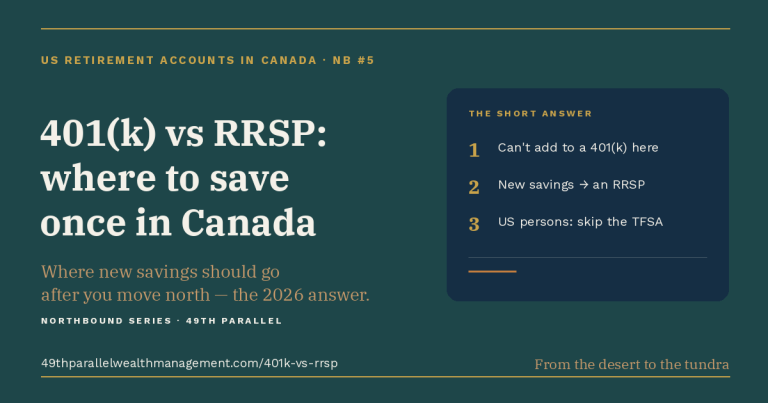
- TFSA caution: The Tax-Free Savings Account is one of Canada’s best savings tools—but if you are a US person, the IRS does not recognize it as tax-advantaged. Earnings inside a TFSA are generally taxable to you each year in the US. This is one of the most common and costly cross-border planning mistakes.
- Currency matters: If your refund arrived in Canadian dollars and your major expenses are in US dollars, consider the timing before you convert.
- Emergency fund: In which currency do you hold your reserves? The answer should reflect where you spend.
Whatever you decide, your refund should be aligned with your cross-border financial planning goals—not just deposited by default.
4. Strategize How to Pay a Tax Bill—Without Creating New Problems
Owing taxes is not a failure. Paying them in the wrong way can be.
Before you pull from an account to cover a balance owing, think through the consequences:
- Withdrawing from an RRSP or RRIF: Canada withholds tax at source—10 to 30 percent depending on the amount—and the withdrawal is also taxable in the US. You may be generating a larger tax event than the one you are trying to solve.
- Selling from a taxable investment account: A capital gain in Canada may also be a reportable event in the US, and the rates and exemptions differ between the two countries.
- Moving money between Canadian and US accounts: Cross-border transfers are legal but must be tracked. If your aggregate Canadian account balances exceeded $10,000 USD at any point during the year, you were required to file an FBAR. Scrambling to move funds at tax time can create reporting obligations you did not anticipate.
If borrowing was part of how you covered this year’s bill, your financial plan should now address repayment—and how to avoid repeating it. Going forward, coordinate your CRA instalment schedule and IRS estimated payment deadlines carefully. Missing either can trigger penalties even if you paid the right total amount.
5. Use Tax Season Momentum to Build (or Refresh) Your Cross-Border Financial Plan
Gathering your financial documents is one of the most painful parts of tax season. But you just did it. For most people, the documents needed for a financial plan are nearly identical to what went into their tax return. So before you file those papers away for another year, use this moment.
For cross-border families, the post-tax-season review is especially valuable because you now have a complete picture in front of you: both returns, your FBAR or T1135 if applicable, your foreign tax credits, your retirement account balances in both countries, and your income from all sources.
This is the ideal time to:
- Review your RRSP or RRIF withdrawal sequence relative to US income and bracket exposure
- Model a Roth conversion while your income is lower or before required minimum distributions begin
- Check your estate documents across both countries—beneficiary designations, powers of attorney, and wills may need to reflect your current residency
- Confirm your FBAR and T1135 obligations were met accurately, not just filed
If common cross-border questions surfaced during filing, this is the right time to get answers before they become problems.
Frequently Asked Questions
The following questions cover the most common concerns cross-border families have after tax season.
1. What should I do with a tax refund as a cross-border family? |
A tax |
2. How do I adjust withholding after filing as a cross-border taxpayer? |
In the |
3. What are the IRS quarterly estimated payment deadlines? |
IRS |
4. What are CRA instalment payment deadlines in Canada? |
CRA |
5. What is FBAR and when do I need to file it? |
FBAR |
6. Should I contribute to an RRSP or Roth IRA with my tax refund? |
It |
7. Is a TFSA good for US citizens or US persons living in Canada? |
No. The |
8. What is deemed disposition and when does it apply? |
Deemed |
9. How do foreign tax credits work for cross-border families? |
Foreign |
10.nWhen should I review my cross-border financial plan? |
Immediately |
At 49th Parallel Wealth Management
Tax season creates clarity. It shows you exactly where you stand financially—what came in, what went out, and what the two governments think of your year.
For cross-border families, that picture is more complex than most. Two returns, two currencies, two sets of rules, and a planning horizon that spans both countries require a coordinated strategy—not two separate ones.
At 49th Parallel Wealth Management, we work with Canadians in the US, Americans in Canada, dual citizens, and cross-border families navigating retirement, relocation, and everything in between. We hold dual licensing in both countries and specialize in Canada-US financial planning that accounts for your full picture.
Tax season is a launchpad, not a finish line. Book a complimentary consultation and let’s build a plan that works on both sides of the border.
From the Desert to the Tundra™