What the SEC’s Crypto ETF Ruling Means for Cross-Border Investors
IMPORTANT DISCLAIMER
This article is for educational purposes only and does not constitute tax, legal, or investment advice. Cross-border tax situations are highly fact-specific. Always consult a qualified cross-border financial advisor and tax professional before making any decisions about your investment accounts, reporting obligations, or estate planning.
On July 29, 2025, the U.S. Securities and Exchange Commission (SEC) approved in-kind creation and redemption mechanisms for Bitcoin and Ethereum ETFs — a structural change that closes the gap between crypto ETFs and traditional commodity ETFs like gold or oil. Most coverage has focused on what this means for institutional flows, NAV tracking, and issuers like BlackRock and Fidelity. Almost none of it addresses what it means if you hold accounts in both Canada and the United States.
If you are a Canadian living in the US, a US citizen with Canadian investment accounts, a snowbird, or anyone straddling both tax systems — this ruling touches you in ways that go well beyond market structure. The tax treatment of crypto ETF gains, the reporting obligations on foreign-held ETFs, the TFSA trap for US persons, and the estate tax exposure for non-citizens holding US-situs assets all intersect with this change. This post works through each one.
What In-Kind Redemptions Actually Changed
Before this ruling, US crypto ETFs were cash-only on redemption. When an authorized participant (AP) — typically a large institutional dealer — wanted to redeem ETF shares, the fund had to sell the underlying Bitcoin or Ether on the open market, convert the proceeds to cash, and pay out fiat. That cash conversion created taxable events inside the fund, generated trading slippage, and widened the gap between the ETF’s share price and its net asset value.
Under the new framework, APs can redeem shares by receiving actual Bitcoin or Ether directly — no cash conversion required. This mirrors the in-kind mechanism used in gold ETFs and oil ETFs for decades. The practical benefits are lower transaction costs, tighter NAV tracking, and the ability to defer capital gains taxation at the fund level, since no sale occurs. The SEC also approved mixed Bitcoin-Ether ETPs, listed options, and higher position limits alongside this change.
Why This Ruling Has Cross-Border Implications
The deferred-gains angle is where the ruling becomes relevant to cross-border planning — but the benefit is not symmetrical across the Canada-US border. The SEC’s in-kind mechanism primarily defers capital gains at the fund level for authorized participants (large institutions). For individual investors holding ETF shares in a brokerage account, the direct gain-deferral benefit is limited. What the ruling does do is make crypto ETFs more efficient and more institutionally mainstream, which is driving more individual cross-border investors to hold Bitcoin and Ethereum ETF exposure in regular brokerage accounts — and that is where the cross-border complexity begins.
THE CROSS-BORDER ISSUE IN ONE SENTENCE As crypto ETFs become easier to own and more widely held, cross-border investors face reporting obligations, tax treatment differences, and account-type traps that domestic-only investors never encounter — and most advisors will not flag. |
FBAR Reporting: Do You Have a Foreign Account Holding a Crypto ETF?
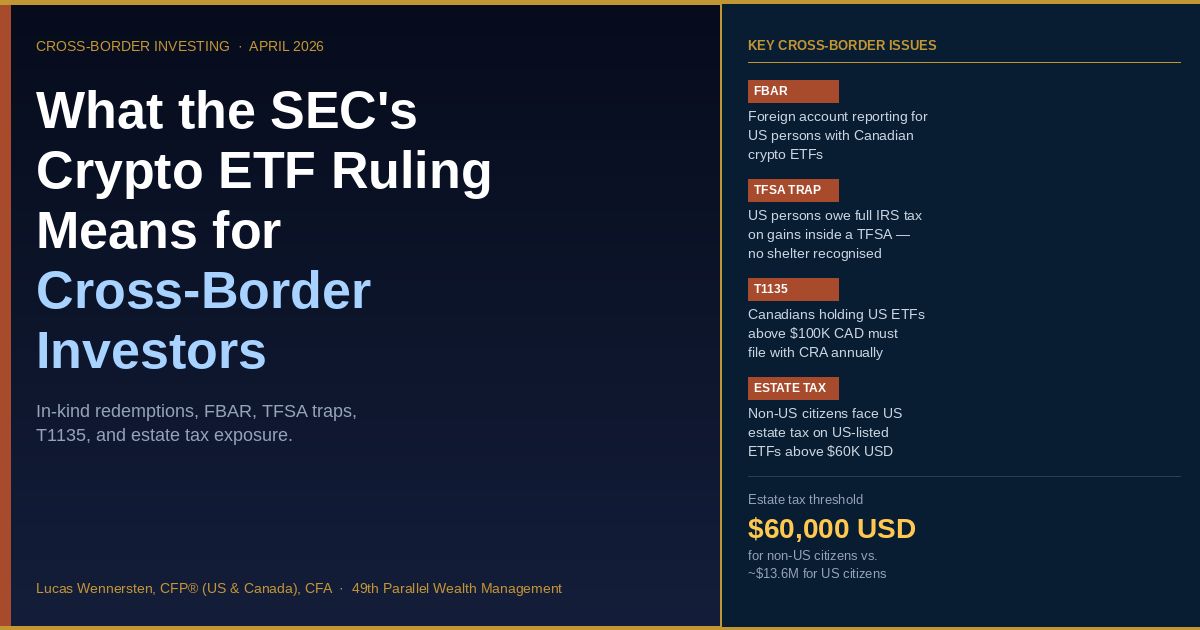
The Report of Foreign Bank and Financial Accounts (FBAR), filed on FinCEN Form 114, requires US persons to report any foreign financial account in which they have a financial interest or signature authority if the aggregate value of all foreign accounts exceeds $10,000 USD at any point during the year.
If you are a US citizen, green card holder, or US tax resident (under the substantial presence test) and you hold a Bitcoin or Ethereum ETF inside a Canadian brokerage account, that Canadian account is a reportable foreign financial account. The ETF itself does not change that obligation. FBAR is triggered by the account, not the asset inside it. Failure to file carries penalties of $10,000 per violation for non-willful failures, and significantly higher for willful failures.
The IRS also requires US persons with foreign financial assets above specified thresholds to file Form 8938 (FATCA Statement of Specified Foreign Financial Assets) separately from the FBAR, on their federal tax return. The two filings are not redundant — they have different thresholds and different regulatory frameworks. Holding Canadian crypto ETFs in a Canadian account implicates both.
For FBAR guidance, see the IRS’s official overview at irs.gov/fbar and Form 8938 at irs.gov/form-8938.
The TFSA Trap: US Persons Holding Canadian Bitcoin ETFs Tax-Free Or Not
Canada has had listed Bitcoin and Ethereum ETFs since 2021 — years ahead of the US. Canadian residents who held crypto ETFs inside a Tax-Free Savings Account (TFSA) accumulated gains completely free of Canadian tax. This is one of the most attractive features of the TFSA.
US PERSONS: THE TFSA IS NOT TAX-FREEThe IRS does not recognise the TFSA as a tax-sheltered account. For a US person — citizen, green card holder, or US tax resident — all income and gains inside a TFSA are fully taxable in the United States in the year they are earned. A Canadian Bitcoin ETF held inside a TFSA by a US person generates US-taxable capital gains and income every year, with no offsetting Canadian tax credit (since Canada collected no tax). The effective result is that the US person pays full US capital gains tax on gains that their Canadian counterpart pays zero on. |
This is not a new rule — it has applied since the TFSA was introduced in 2009. But the popularity of Canadian crypto ETFs inside TFSAs has made it far more common, and the SEC’s ruling now increases the number of US-listed ETF alternatives available. For US persons with Canadian TFSAs holding crypto ETF positions, the practical advice is to evaluate whether the position should be in a different account structure. See the CRA’s TFSA overview at
canada.ca/tfsa for account rules from the Canadian side. For help structuring this correctly, our cross-border tax planning work addresses exactly this kind of account-level analysis.
Canada vs. the US: Capital Gains Treatment Is Not the Same
One of the key benefits the SEC highlighted in the in-kind redemption ruling is the potential to defer capital gains taxation. That deferral benefit reads differently depending on which country’s tax system applies to you.
Factor | Canada (CRA) | United States (IRS) |
Capital gains inclusion rate | 50% included in income (2/3 proposed for gains over $250K CAD under Budget 2024) | 100% included in income; taxed at 0%, 15%, or 20% long-term rate depending on bracket |
ETF in-kind redemption gain deferral | No direct equivalent mechanism in Canada; CRA taxes disposition at fair market value | In-kind redemption by APs defers gain at fund level; individual investors still trigger gain on ETF share sale |
Crypto ETF short-term vs. long-term distinction | No distinction; all capital gains taxed at 50% inclusion regardless of holding period | Gains on ETF held less than 12 months taxed as ordinary income; over 12 months at preferential long-term rates |
Tax treaty treatment of crypto gains | Canada-US Tax Treaty covers capital gains; specific crypto ETF provisions not yet codified | Treaty generally allocates capital gains to country of residence; dual-resident situations require careful analysis |
For cross-border investors, the practical takeaway is that a US resident holding a Canadian crypto ETF may face a higher effective tax rate than a purely Canadian resident holding the same asset — even before accounting for FBAR and TFSA complications. The in-kind ruling improves ETF efficiency in the US market, but it does not flatten the cross-border tax differential. Our
cross-border financial planning FAQs cover many of the tax treaty questions that come up in this context.
T1135: Canadians Holding US-Listed Crypto ETFs Above $100,000 CAD
For Canadian residents holding US-listed Bitcoin or Ethereum ETFs in a US brokerage account, the CRA’s Foreign Income Verification Statement — Form T1135 — may apply. If the total cost amount of all specified foreign property exceeds $100,000 CAD at any point during the year, Canadian residents must file T1135 with their annual tax return.
A US-listed Bitcoin ETF (such as IBIT, FBTC, or any of the SEC-approved funds) held in a US brokerage account qualifies as specified foreign property under CRA rules. The filing deadline matches the personal tax return deadline (April 30 for most Canadians, June 15 for self-employed). Penalties for failure to file start at $25 per day to a maximum of $2,500, with higher penalties for gross negligence.
T1135 applies to the account holding the ETF, not just the ETF itself. A Canadian with a US brokerage account holding a mix of US equities and a Bitcoin ETF that collectively exceed the threshold must file. See CRA’s guidance at canada.ca/t1135 for the full list of specified foreign property and filing instructions. This is one of the most commonly missed obligations we see in cross-border financial planning reviews.
US Estate Tax Exposure for Non-US Citizens Holding US-Listed Crypto ETFs
This one catches cross-border investors off guard more than almost any other issue. Non-US citizens who hold US-situs assets — assets legally located in the United States for estate tax purposes — are subject to US estate tax on those assets above a threshold of just $60,000 USD. This compares to the roughly $13.6 million USD threshold (as of 2024, though subject to change) that applies to US citizens and domiciliaries.
ESTATE TAX EXPOSURE ON US-LISTED CRYPTO ETFsA Bitcoin ETF listed on a US exchange (NYSE Arca, Nasdaq, CBOE) and held in a US brokerage account is almost certainly US-situs property for estate tax purposes. A Canadian resident who is not a US citizen and holds $200,000 CAD worth of IBIT in a US brokerage account has exceeded the $60,000 USD threshold and faces US estate tax on that excess at graduated rates reaching 40% on the taxable amount. The Canada-US Tax Treaty provides some relief through a prorated credit, but it does not eliminate the exposure — and it requires active planning to access. |
This is one of the core issues we address in cross-border estate planning work. Holding the same crypto ETF inside a Canadian brokerage account — where a Canadian-listed ETF would be non-US-situs — is one straightforward structural solution, though it comes with its own tax treatment considerations for US persons (as covered in the TFSA section above). The right answer depends on your specific residency status, citizenship, and the size of your cross-border holdings.
What Cross-Border Investors Should Review Now
The SEC’s in-kind redemption ruling is a positive structural development for crypto ETFs broadly. But it is also a good trigger to audit your current cross-border crypto ETF holdings against four questions:
- Account location: Is your crypto ETF in a US account, a Canadian account, or both? The country of the brokerage account determines FBAR obligations (for US persons), T1135 obligations (for Canadians), and estate tax exposure.
- Account type: Is the ETF inside a TFSA, RRSP, RRIF, taxable account, or US IRA? The account type governs whether gains are sheltered in Canada, whether the IRS treats them as taxable, and whether PFIC rules may apply to Canadian-listed funds.
- Residency and citizenship status: Are you a US person under IRS definitions? A Canadian resident? A dual citizen? Your residency and citizenship status determines which reporting regimes apply and which treaty provisions may offer relief.
- Aggregate thresholds: Have your foreign holdings crossed the $10,000 USD FBAR threshold, the $75,000–$300,000 USD FATCA threshold, the $100,000 CAD T1135 threshold, or the $60,000 USD estate tax threshold? Multiple thresholds can be triggered simultaneously on the same holdings.
If any of these questions prompt uncertainty, that is the right signal to get a professional cross-border review before adding to or restructuring crypto ETF positions. Book a complimentary consultation to walk through your specific situation.
FREQUENTLY ASKED QUESTIONS |
1. Does the SEC’s in-kind redemption ruling directly benefit individual Canadian investors?
Not directly. The in-kind creation and redemption mechanism operates between ETF issuers and authorized participants — large institutional dealers, not individual retail or HNW investors. The indirect benefits — tighter NAV tracking, lower overall fund costs, and improved institutional liquidity — flow through to all ETF holders over time. For Canadian investors specifically, the more significant development is that a wider and more efficient set of US-listed Bitcoin and Ethereum ETF options are now available, which affects the account-location and reporting decisions outlined in this post.
2. Do I need to report a US Bitcoin ETF on my Canadian tax return?
If you are a Canadian resident holding a US-listed Bitcoin ETF in a US brokerage account, yes — likely in two ways. First, T1135 applies if the total cost of all specified foreign property exceeds $100,000 CAD at any point in the year. Second, any capital gains or income earned in the account must be reported on your Canadian return and converted to CAD at the applicable exchange rate. Canada taxes capital gains at a 50% inclusion rate (with proposed changes for gains above $250,000 CAD). The Canada-US Tax Treaty may provide a foreign tax credit for any US tax paid on the same gain.
3. Can a US person hold a Bitcoin ETF inside a TFSA without US tax consequences?
No. The IRS does not recognise the TFSA as a tax-exempt account. All income and gains earned inside a TFSA are fully taxable in the United States in the year earned, for any US person — regardless of how Canada treats those gains. A US person holding a Bitcoin ETF inside a TFSA will owe US capital gains tax on any appreciation, with no offsetting Canadian tax credit, since Canada taxed nothing. This makes the TFSA one of the least efficient account structures for US persons holding volatile or high-growth assets like crypto ETFs.
4. How does capital gains treatment on a crypto ETF differ between Canada and the US?
In Canada, capital gains are subject to a 50% inclusion rate, meaning only half of the gain is added to taxable income. The effective tax rate depends on the investor’s marginal income tax rate. In the US, capital gains on ETF shares held for more than 12 months are taxed at preferential long-term rates of 0%, 15%, or 20%, depending on income. Gains on ETF shares held for 12 months or less are taxed as ordinary income. Neither country distinguishes between a “crypto” ETF and any other ETF for capital gains purposes — what matters is the type of gain and the holding period.
5. What is FBAR and does it apply to my crypto ETF holdings?
FBAR (FinCEN Form 114) requires US persons to report any foreign financial account with an aggregate value exceeding $10,000 USD at any point during the calendar year. If you hold a Bitcoin or Ethereum ETF inside a Canadian brokerage account, that account is a reportable foreign financial account — FBAR is triggered by the account, not the asset inside it. The filing deadline is April 15, with an automatic extension to October 15. Non-willful failure to file carries penalties up to $10,000 per violation; willful failure carries significantly higher penalties.
6. What is Form T1135 and when does it apply to my crypto ETF?
T1135 is the CRA’s Foreign Income Verification Statement, required from Canadian residents whose specified foreign property exceeds $100,000 CAD in total cost at any point during the year. A US-listed Bitcoin or Ethereum ETF held in a US brokerage account qualifies as specified foreign property. T1135 must be filed with the annual Canadian income tax return. Penalties begin at $25 per day to a maximum of $2,500, with additional penalties for gross negligence or intentional failure to disclose.
7. Does the in-kind redemption mechanism help me personally defer capital gains as an individual investor?
Not directly. In-kind redemptions allow authorized participants — institutional dealers who create and redeem large blocks of ETF shares — to exchange Bitcoin or Ether without triggering a cash sale inside the fund. This reduces portfolio turnover and embedded taxable events at the fund level, which is a structural improvement for all shareholders. As an individual ETF holder, your personal capital gain is still triggered when you sell your ETF shares. The in-kind mechanism does not allow individual investors to redeem shares by delivering or receiving crypto directly.
8. Can a Canadian resident face US estate tax on a US-listed Bitcoin ETF?
Yes. Non-US citizens who are not domiciled in the United States are subject to US estate tax on US-situs property above a threshold of $60,000 USD. A Bitcoin ETF listed on a US exchange and held in a US brokerage account is US-situs property for estate tax purposes. The Canada-US Tax Treaty provides a prorated unified credit that reduces, but does not eliminate, this exposure for Canadian residents. Holding an equivalent Canadian-listed Bitcoin ETF in a Canadian brokerage account eliminates the US-situs concern, though it introduces other tax and reporting considerations for US persons.
9. Should I hold my crypto ETF in Canada or the US?
There is no universal answer — it depends on your citizenship, tax residency, account types available, and the size of your holdings. For a pure Canadian resident with no US obligations, a Canadian-listed Bitcoin ETF in a taxable Canadian account is simpler from a reporting perspective. For a US citizen living in Canada, a US-listed ETF in a US taxable account avoids PFIC (passive foreign investment company) issues that can arise with Canadian-listed funds. For a cross-border family with members in both countries, the account structure requires deliberate planning around both tax systems simultaneously.
10. How do I know if the SEC ruling has changed my cross-border investment strategy?
The ruling itself does not change any reporting obligations or tax treatment for individual investors — those rules exist independently of ETF structure. What the ruling does is expand the range of efficient US crypto ETF options available and signal that institutional adoption will accelerate, which may affect your portfolio exposure decisions. If you hold crypto ETF positions in accounts across both countries and have not done a structured cross-border review, the ruling is a reasonable prompt to do one. Our team can walk through the specific account-by-account analysis as part of our cross-border financial planning work.
READY TO REVIEW YOUR CROSS-BORDER INVESTMENT ACCOUNTS?Crypto ETF positions that look straightforward in one country become significantly more complex when you hold accounts on both sides of the border. FBAR, T1135, TFSA traps, capital gains treatment differences, and estate tax exposure can all apply simultaneously — and most domestic advisors are not equipped to navigate the full picture. Lucas Wennersten holds dual CFP® designations (US and Canada) and the CFA credential. 49th Parallel Wealth Management specialises exclusively in cross-border clients. Book a complimentary consultation — or explore our cross-border investment management and cross-border tax planning services. |