Medical Expense Deductions: Canada vs the US — What Cross-Border Families Need to Know
By Lucas Wennersten, CFP® (US & Canada), CFA · 8 minute read · Updated May 14, 2026
Medical expenses can represent a significant financial burden for families managing chronic conditions, aging parents, or unexpected health events. While both Canada and the United States offer tax relief for eligible medical expenses, the way those expenses are claimed — and how much actual tax benefit they generate — differs substantially between the two systems.
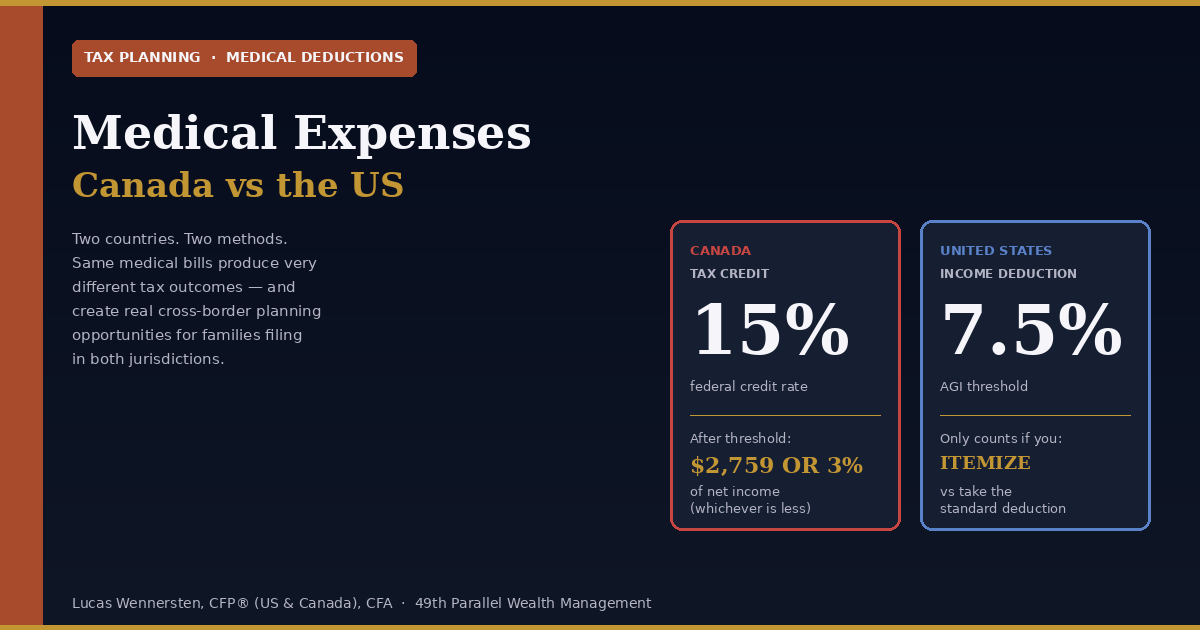
Canada uses a non-refundable tax credit at the lowest federal bracket rate (15%). The US uses a deduction against income, available only above 7.5% of AGI and only if you itemize. The two systems can produce wildly different tax outcomes from the same medical bills — sometimes a meaningful deduction, sometimes almost nothing.
For cross-border families, this asymmetry creates planning opportunities and traps. This article walks through how medical expenses are treated on each side, the cross-border planning considerations that matter most, and the most common mistakes we see in practice.
How Medical Expenses Are Treated on Canadian Tax Returns
In Canada, eligible medical expenses do NOT create a deduction from income. Instead, they generate a non-refundable tax credit that reduces taxes payable. The credit is calculated at the lowest federal bracket rate (15%) plus your provincial credit rate, regardless of your actual marginal rate.
Step 1: Determine eligible medical expenses
Eligible expenses include:
- Prescription medications (over-the-counter drugs generally don’t qualify even with a prescription)
- Dental care, including orthodontics
- Vision care including prescription glasses and contact lenses
- Medical devices and equipment (hearing aids, mobility aids, CPAP machines)
- Therapy and treatment costs from licensed practitioners
- Travel expenses for medical care (when local services aren’t available, generally 40+ km away)
- Premiums paid to private health insurance plans (with restrictions)
- Attendant care for those with severe disabilities
Only qualifying out-of-pocket expenses that were not reimbursed (by insurance, employer, or otherwise) can be claimed.
Step 2: Apply the income threshold
You subtract the lesser of: 3% of your net income, OR the annual medical expense threshold ($2,759 for 2026). This threshold limits the amount of medical expenses that can be used toward the credit.
Step 3: Calculate the tax credit
The amount above the threshold is multiplied by 15% federally, producing the non-refundable federal tax credit. Provincial credits stack on top, with rates that vary by province (Ontario 5.05%, BC 5.06%, Alberta 10%, etc.).
The 12-Month Claim Period: A Planning Lever Most People Miss
One important Canadian rule that’s often missed: medical expenses don’t have to be claimed for the calendar year. You can claim expenses for ANY 12-month period ending in the tax year, as long as no expense is claimed twice.
This creates real planning opportunities:
- Bunch large expenses into one 12-month window to clear the 3% threshold once instead of twice
- Time elective procedures (orthodontics, vision correction, cosmetic dental) toward the end of one tax year and start of the next
- Coordinate around major medical events that span calendar years (surgeries, treatment cycles)
- Useful when one spouse has lower income — the 3% threshold is lower for the lower-income spouse, so claiming on their return often produces a larger credit
Spousal Optimization in Canada
Canadian medical expenses can be combined and claimed on either spouse’s return — even though Canada has no joint filing. The lower-income spouse usually produces the larger credit because the 3% net income threshold is lower for them, leaving more expense above the threshold to be credited at 15%.
Example: A couple has $8,000 in combined medical expenses. The higher-earning spouse has $120,000 net income (3% = $3,600). The lower-earning spouse has $45,000 net income (3% = $1,350, but capped at $1,350 since it’s below the $2,759 maximum). Claiming on the lower-income spouse’s return uses a $1,350 threshold (vs $2,759 maximum), leaving $6,650 to credit instead of $5,241. Federal credit of $997.50 vs $786.15 — about $211 more in tax savings, plus provincial.
How Medical Expenses Are Treated on US Tax Returns
In the US, medical expenses are an itemized deduction on Schedule A — they reduce taxable income directly (not just tax owed). But two important conditions must be met: you must itemize rather than take the standard deduction, and expenses must exceed 7.5% of your adjusted gross income (AGI).
Step 1: Identify qualified medical expenses
Qualified unreimbursed expenses include (not exhaustive):
- Doctor, dentist, and hospital bills
- Prescription drugs (US is stricter than Canada — no OTC drugs even with prescription)
- Dental and vision care
- Long-term care services for chronically ill (with specific certification requirements)
- Mileage for medical treatment (21¢/mile for 2024, verify 2026 rate)
- Health insurance premiums in limited cases (generally only for self-employed or pre-tax payroll portions)
- Capital improvements to a home for medical purposes (ramps, lifts) to the extent they don’t increase property value
Step 2: Apply the 7.5% AGI threshold
You may deduct medical expenses only to the extent they exceed 7.5% of your adjusted gross income (AGI). For example, with AGI of $100,000, only medical expenses above $7,500 are deductible. Per IRS Publication 502, this threshold has been the permanent rate since 2019.
Step 3: Itemize, or lose the deduction entirely
Here’s the catch: medical expenses are only useful if you itemize. With the standard deduction substantially raised under the Big Beautiful Bill — see our BBB $15M estate exemption analysis for context — roughly 90% of US taxpayers now take the standard deduction. That means the medical expense deduction is mostly relevant for: (1) high-income filers with significant out-of-pocket medical costs, (2) families dealing with major medical events in one tax year, or (3) seniors with long-term care expenses. Everyone else gets no benefit from this deduction at all.
HSAs, FSAs, and Pre-Tax Medical Spending in the US
Outside the itemized deduction path, the US offers two significant tax-advantaged accounts for medical expenses — Health Savings Accounts (HSA) and Flexible Spending Accounts (FSA). These produce tax benefits without requiring you to clear the 7.5% AGI threshold or itemize. They’re often the better lever for Americans with predictable medical spending.
- HSA — Health Savings Account: Pre-tax contributions (2026 limits: $4,400 single / $8,800 family + $1,000 age-55 catch-up). Triple tax advantage — deductible going in, tax-free growth, tax-free withdrawals for qualified medical. Requires a High-Deductible Health Plan (HDHP).
- FSA — Flexible Spending Account: Pre-tax payroll contributions (2026 limit ~$3,300). Use-it-or-lose-it rules apply (some carryover allowed depending on plan). Employer-sponsored only.
- Cross-border note: HSAs are NOT recognized as tax-deferred by CRA. If you become a Canadian tax resident, your HSA balance is treated as a taxable trust under CRA rules — major problem if you don’t address it before moving north.
Disability Tax Credit (DTC) — The Canadian Companion
Beyond the standard medical expense credit, Canada offers the Disability Tax Credit (DTC) — a separate non-refundable credit for people with severe and prolonged physical or mental impairment. The DTC base amount is $9,872 federally for 2026, producing a federal credit of about $1,481, plus provincial. Children under 18 get an additional supplement. The DTC is also the gateway to the Registered Disability Savings Plan (RDSP) — Canada’s tax-advantaged disability savings vehicle.
Cross-border families with a disabled family member should consider DTC eligibility carefully. The certification process requires a Form T2201 signed by a qualified practitioner — it’s not automatic. Approval is retroactive to the year of onset, allowing back-claims of up to 10 years.
Side-by-Side: Canada vs US Medical Tax Treatment
Feature | Canada | United States |
Type of tax relief | Non-refundable tax credit | Itemized deduction |
Income threshold | Lesser of 3% net income OR $2,759 (2026) | 7.5% of AGI |
Tax impact | Reduces tax payable (15% federal + provincial) | Reduces taxable income (at marginal rate) |
Marginal rate benefit | No — fixed at 15% federally | Yes — full marginal rate benefit |
Requires itemizing? | No — claim if you have receipts | Yes — and most US filers don’t |
12-month claim flexibility | Yes — any 12-month period ending in tax year | No — calendar year only |
Spousal combination | Yes — either spouse can claim | Joint filing handles this by default |
Pre-tax accounts | Limited (HCSA via employer) | HSA / FSA / HRA available |
Disability companion credit | DTC + RDSP available | ABLE accounts (limited) |
Cross-Border Planning Considerations
For families with dual filing obligations or those moving between countries, several considerations matter:
Timing across tax years and jurisdictions
If you’re moving from Canada to the US or vice versa, the timing of major medical expenses around the residency-change date can change the tax outcome significantly. A surgery in December (Canada-resident year) may be more valuable than the same surgery in January (US-resident year), or vice versa, depending on income levels in each country and itemizing status in the US.
Coordinating expenses between spouses with differing incomes
When one spouse is a Canadian resident and the other is a US resident — a common cross-border family pattern — medical expenses generally must be split based on which spouse paid and where they reside. Documentation of WHO paid for WHAT matters more than in single-country couples.
Residency status affects eligibility
Non-residents of Canada generally cannot claim Canadian medical expenses for the portion of the year they were non-resident. Similarly, the US 7.5% AGI test applies only to AGI from the period you were a US resident. Cross-border tax planning often comes down to careful date-of-residency-change documentation — the year you move is rarely a simple split-year calculation.
Avoiding duplicate or disallowed claims
If the same expense is reimbursed by US health insurance, it’s not deductible on EITHER country’s return — even if the expense was incurred in Canada. Conversely, Canadian provincial health coverage means many doctor visits in Canada don’t generate any ‘expense’ to claim. The reimbursement test trumps the geography test.
The Bottom Line
Medical expenses are one of the many tax areas where personal circumstances, income levels, and country-specific rules intersect in complex ways. What creates a meaningful deduction in the US — long-term care, surgery, in-vitro treatments — may produce only a modest credit in Canada, and vice versa.
For cross-border families, careful planning is essential to ensure medical costs are claimed correctly and efficiently on each side of the border. If you have cross-border tax exposure, professional guidance can help align your healthcare spending decisions with your broader financial and tax strategy. Book a complimentary consultation with 49th Parallel Wealth Management to coordinate medical spending across both tax systems.
Frequently Asked Questions
Q: How are medical expenses treated differently in Canada vs the US?
A: Canada provides a non-refundable tax credit at 15% federally, after subtracting the lesser of 3% of net income or $2,759 (2026 annual limit). The US provides an itemized deduction on Schedule A for medical expenses exceeding 7.5% of AGI — but only if you itemize, which only about 10% of US filers do under current standard deduction rules.
Q: What is the medical expense threshold in Canada for 2026?
A: For 2026, the threshold is the LESSER of 3% of your net income OR $2,759 (the annual maximum). For example, if your net income is $80,000, your 3% threshold is $2,400 — that’s below the maximum, so $2,400 is your threshold. If your net income is $120,000, your 3% calculation is $3,600 — but the cap is $2,759, so $2,759 is your threshold.
Q: What is the US medical expense AGI threshold?
A: 7.5% of your adjusted gross income (AGI). This has been the permanent threshold since 2019. For example, with AGI of $100,000, you can deduct medical expenses only above $7,500 — and only if you itemize rather than taking the standard deduction.
Q: Can I claim medical expenses if I take the US standard deduction?
A: No. The medical expense deduction is an itemized deduction on Schedule A. If you take the standard deduction (which most US filers do), you cannot claim medical expenses. The only US workarounds are pre-tax accounts like HSA, FSA, or HRA — which produce tax benefits without requiring itemization.
Q: What is the 12-month rule for Canadian medical expenses?
A: Canada allows you to claim medical expenses for ANY 12-month period ending in the tax year. This means you can choose a 12-month window that maximizes your credit — for example, if you had major dental work in November 2024 and another batch in October 2025, you can claim them together in your 2025 return using a December 2024-November 2025 period. The flexibility lets you cross the 3% threshold once instead of twice.
Q: Which Canadian spouse should claim the medical expense credit?
A: Generally the lower-income spouse, because the 3% net income threshold is lower for them — leaving more expense above the threshold to be credited at 15%. The exception is when the lower-income spouse has insufficient income to use the credit fully (the credit is non-refundable, so unused portions don’t generate a refund). Modeling both scenarios is worthwhile when total expenses are significant.
Q: Are health insurance premiums deductible in Canada or the US?
A: Canada: Premiums for private health insurance plans can qualify as eligible medical expenses, but premiums paid for employer-provided group plans generally don’t qualify (because they’re already paid with pre-tax dollars in most provinces). US: Premiums are generally deductible only if you’re self-employed (above-the-line), or if you paid them post-tax (rare). Premiums paid through payroll on a pre-tax basis aren’t deductible because they were never taxed.
Q: How does the US 7.5% AGI threshold interact with cross-border income?
A: If you became a US tax resident mid-year (e.g. arrived in May), your AGI for medical expense threshold purposes is generally your AGI for the US-resident portion of the year. The 7.5% test is calibrated against the partial-year AGI. Coordinate residency-change planning with your tax preparer — small timing decisions on residency dates can move you above or below the threshold.
Q: Does the Canadian Disability Tax Credit (DTC) interact with medical expenses?
A: Yes. The DTC is a separate non-refundable credit from the medical expense credit — you can claim both if the disabled person qualifies. The DTC base amount is $9,872 federally for 2026, producing a federal credit of about $1,481 plus provincial. Approval requires Form T2201 signed by a qualified practitioner. The DTC is also the gateway to the Registered Disability Savings Plan (RDSP), which is one of Canada’s most powerful disability-related savings vehicles.
This article is for general educational purposes and is not tax, legal, or investment advice. Medical expense thresholds, qualifying expense categories, and eligibility rules change periodically. The 2026 figures cited here are confirmed at publication; verify current values with the IRS, CRA, or a qualified cross-border tax preparer before filing.