The Tax Reality No One Tells Americans Moving to Canada
The IRS follows you across the border. What US worldwide taxation, FBAR, FATCA, and the Canada-US Tax Treaty mean for your finances when you move north.
IMPORTANT NOTE This |
FREE DOWNLOAD The American’s 2026 Canada Relocation Checklist Everything you need to do before, during, and after Free |
By Lucas Wennersten, CFP® (US & Canada), CFA Founder, 49th | Published: April 2026 Reading time: |
AMERICANS IN CANADA SERIES Monday: How Long Can an American Stay in Canada? Tuesday: What Does Canada Actually Cost an American? Wednesday: The Tax Reality No One Tells Americans Moving to Canada |
On Monday we covered how long you can legally stay in Canada. On Tuesday we walked through what the move actually costs. Today we get to the part that surprises almost every American who crosses the border seriously: the IRS does not stop caring about you when you leave.
The United States is one of only two countries in the world — the other is Eritrea — that taxes its citizens on worldwide income regardless of where they live. Move to Canada, pay Canadian taxes, build a Canadian life — you still file a US federal tax return every year. You still report your Canadian bank accounts. You still comply with FBAR and FATCA. And the Canada-US Tax Treaty, while genuinely helpful, does not eliminate the US obligation.
This is the tax reality most Americans do not fully understand until they are already living in Canada and the first filing season arrives. Here is the full picture.
Americans Moving to Canada,The IRS Follows You: US Worldwide Taxation Explained
US citizenship carries a permanent tax obligation. It does not matter where you live, where your income is earned, or where you pay your taxes. As a US citizen, you are required to file a US federal income tax return every year and report all income from all sources worldwide.
This is not a corner case or a technicality. It is the fundamental structure of the US tax system, and it applies to every American who moves abroad — including those who have lived outside the US for decades.
What This Means in Practice
- You file a US return every year at the same April 15 deadline (or October 15 with extension) regardless of where you live.
- You report your Canadian employment income, Canadian rental income, Canadian investment income, Canadian pension income, and any other worldwide income on your US return.
- You pay tax to the US on that income — though the foreign tax credit (discussed below) typically eliminates most or all double taxation.
- You report your Canadian financial accounts annually on separate forms even if no tax is owed.
THE FOREIGN EARNED INCOME EXCLUSION — A COMMON MISCONCEPTION Many Americans have heard of the Foreign Earned Income Exclusion (FEIE), which allows US citizens abroad to exclude a portion of foreign earned income from US tax (up to $126,500 in 2024). While the FEIE can help some Americans in Canada, it is not the primary tool for most cross-border filers. It covers only earned income — not investment income, rental income, pensions, or Social Security — and it cannot be used alongside the foreign tax credit on the same income. Most Americans moving to Canada with retirement income or investment assets find the foreign tax credit structure more advantageous. Get specialist advice before choosing your approach. |
How Canada Claims You: The Canadian Tax Residency Test
While the US uses citizenship as its tax hook, Canada uses residency. The moment you establish sufficient ties to Canada, the CRA considers you a Canadian tax resident and taxes your worldwide income from that date forward.
Canada does not use a simple day count to determine residency. It uses a ties-based test that looks at the totality of your connections to Canada.
Significant Residential Ties
- A home in Canada — whether owned or rented, if available for your use on an ongoing basis
- A spouse or common-law partner who is a Canadian resident
- Dependents who are Canadian residents
Secondary Residential Ties
- Canadian bank accounts or investment accounts
- Canadian credit cards or driver’s licence
- Canadian provincial health coverage
- A Canadian vehicle
- Canadian social, professional, or recreational ties
The CRA assesses the full picture. An American who arrives in Canada with a rented apartment, a provincial health card, and a Canadian bank account is almost certainly a Canadian tax resident from arrival. The date of deemed residency affects every tax calculation that follows.
DEEMED ACQUISITION ON ARRIVAL When you become a Canadian tax resident, Canada treats you as having sold and immediately reacquired all your assets at fair market value on the date of arrival. This is the deemed acquisition cost — it sets your Canadian cost base going forward. Canada will tax only gains that occur after you arrive, not the appreciation that happened while you were a US resident. This is actually favourable — it means pre-arrival gains in your brokerage accounts do not attract Canadian capital gains tax. Source: Canada Revenue Agency. |
The Canada-US Tax Treaty: What It Does and What It Doesn’t Do For Americans Moving to Canada
The Canada-United States Tax Convention has been in force since 1980 and was most recently updated in 2007. It is a comprehensive bilateral agreement that coordinates the two countries’ tax systems and prevents most double taxation.
What the Treaty Does
- Assigns primary taxing rights over different types of income to one country, with the other country providing a credit to eliminate double taxation
- Protects US retirement accounts (IRAs, 401(k)s) from double taxation on withdrawals
- Allows Roth IRA withdrawals to be recognised as tax-free in Canada (with a required election)
- Coordinates Social Security and pension income so it is generally taxed only in the country of residence
- Provides tie-breaker rules for determining which country has the primary residency claim when a person qualifies as a resident of both
What the Treaty Does Not Do
- Eliminate your US filing obligation — you still file a US return every year
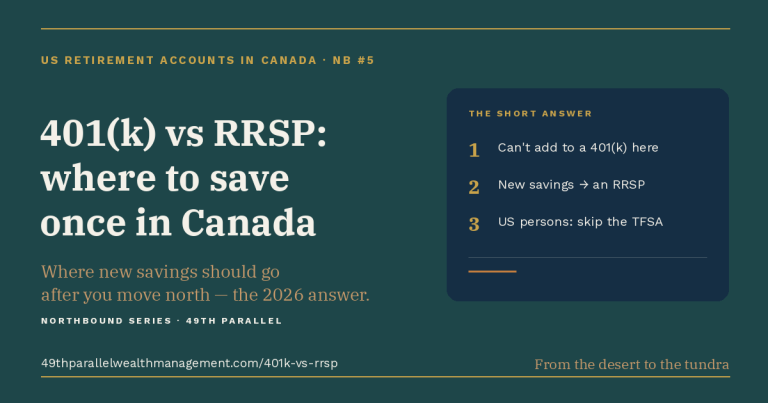
- Protect your TFSA from US taxation — TFSAs have no treaty protection and income earned inside a TFSA is fully taxable to the IRS
- Protect all Canadian trusts from US taxation — certain Canadian registered plans create complex US reporting obligations
- Automatically apply — many treaty benefits require a specific election to be made on your tax return
THE TFSA WARNING FOR AMERICANS IN CANADA If you are a US citizen living in Canada, your Tax-Free Savings Account (TFSA) is not tax-free for US purposes. The Canada-US Tax Treaty provides no protection for TFSAs. Income earned inside your TFSA — dividends, interest, capital gains — is fully taxable to the IRS annually, and the TFSA itself may be treated as a foreign trust requiring additional reporting. This is one of the most consequential financial differences between Americans and Canadians in Canada. It should factor into your account structure from day one. |
Your US Retirement Accounts in Canada
This is where most Americans have their most pressing questions, and where the treaty is most useful.
Roth IRA — Your Most Valuable Cross-Border Account
The Roth IRA is the single most valuable US account to hold as an American in Canada. Under the Canada-US Tax Treaty, qualified Roth IRA withdrawals are recognised as tax-free in Canada — the same way they are in the US. This makes the Roth IRA a uniquely powerful vehicle: no US tax on withdrawal, and no Canadian tax on withdrawal.
CRITICAL: THE ROTH IRA ELECTION Treaty protection for your Roth IRA is not automatic. You must file an election with the CRA in the year you become a Canadian resident to claim treaty protection. If you miss this election, the CRA can treat income and gains inside your Roth IRA as fully taxable in Canada. This election is filed as part of your Canadian tax return but is easy to overlook without specialist guidance. Do not assume your Roth IRA is protected without confirming the election has been made. |
Traditional IRA and 401(k)
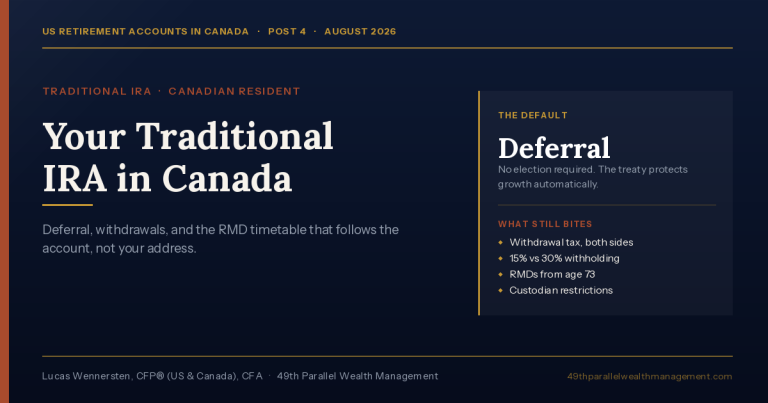
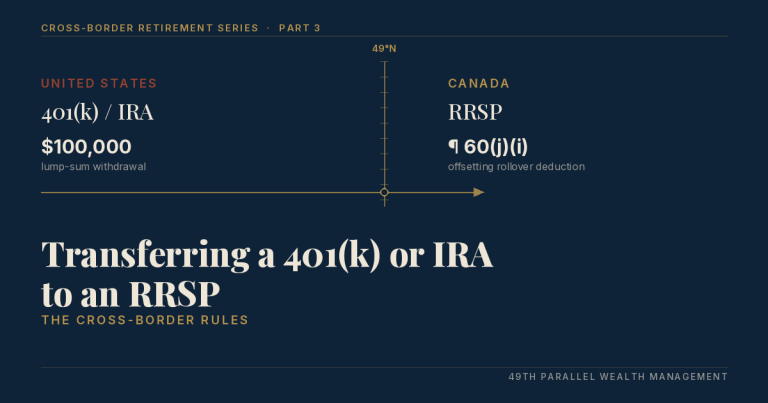
Traditional IRAs and 401(k) accounts are recognised under the treaty as pension plans. Withdrawals are taxable in Canada as income, but you receive a foreign tax credit for any US withholding tax withheld. The treaty prevents double taxation, but does not exempt withdrawals from Canadian income tax. You will pay Canadian rates on withdrawals, with a credit for amounts withheld by the US.
Required Minimum Distributions continue to apply once you reach the applicable age — Canada does not change this US-side obligation.
Social Security in Canada
Under the treaty, US Social Security benefits received by a Canadian resident are taxed only in Canada — not in the United States. Canada includes 85 percent of the Social Security amount in your Canadian taxable income, consistent with how Canada treats OAS and CPP benefits. For most recipients, this is a favourable treatment.
FBAR and FATCA: The Reporting Obligations That Never Stop
Beyond the annual income tax return, Americans in Canada face two significant reporting regimes that are separate from the tax return itself.
FBAR — FinCEN Form 114
The Report of Foreign Bank and Financial Accounts (FBAR) must be filed annually with the Financial Crimes Enforcement Network (FinCEN) if the aggregate value of your foreign financial accounts exceeds $10,000 USD at any point during the calendar year. As an American in Canada, your Canadian chequing accounts, savings accounts, investment accounts, and registered accounts (RRSP, TFSA, LIRA) are all potentially reportable. The FBAR is due April 15 with an automatic extension to October 15. Penalties for non-filing are severe.
FATCA — IRS Form 8938
The Foreign Account Tax Compliance Act requires US citizens to report foreign financial assets above certain thresholds on IRS Form 8938 filed with the tax return. The threshold for US residents abroad is $200,000 USD on the last day of the year (or $300,000 at any point). FATCA also requires Canadian financial institutions to identify and report US account holders to the CRA, which shares the information with the IRS. Your Canadian bank almost certainly already knows you are a US person and is reporting accordingly.
| FBAR (FinCEN Form 114) | FATCA (Form 8938) | |
| Filed with | FinCEN (separate from IRS) | IRS (attached to tax return) |
| Threshold | $10,000 USD aggregate at any point in year | $200,000 USD at year-end or $300,000 at any point (US persons abroad) |
| Deadline | April 15 (auto-extended to October 15) | Same as tax return (April 15 / October 15) |
| Penalty | Up to $10,000 per violation (non-wilful); up to $100,000 or 50% of account balance per violation (wilful) | Up to $10,000 for failure to disclose; up to $50,000 for continued failure after IRS notice |
The Three Things That Genuinely Surprise Americans After the Move
- The Roth IRA election is not automatic. Almost every American who moves to Canada and has a Roth IRA is surprised to learn they need to proactively file an election with the CRA to protect it. The election must be made in the year of arrival. Missing it in year one can create significant complications.
- Their TFSA creates a US tax problem. Many Americans who marry Canadians or spend years in Canada before establishing tax residency already have TFSAs by the time they formalise their status. They discover that the TFSA — which they have been treating as tax-free savings — is actually generating US taxable income and potentially triggering foreign trust reporting requirements.
- The paperwork bill. Dual filing is significantly more expensive than single-country tax compliance. A cross-border American in Canada typically needs both a US-licensed CPA and a Canadian tax specialist, or a dual-qualified firm. Budget for this before you move, not after the first filing season arrives.
The Bottom Line
Moving to Canada as an American is entirely manageable from a tax perspective. The Canada-US Tax Treaty is well-developed, the foreign tax credit generally prevents true double taxation, and the two systems are more coordinated than many people expect.
But the coordination is not automatic. It requires elections, specific filings, and deliberate account structure decisions that need to be made before and immediately upon arrival — not retroactively once problems have already developed. The TFSA issue, the Roth election, and the FBAR obligation are not obscure technicalities. They are the standard compliance reality for every American in Canada.
Thursday’s post covers what Americans most commonly get wrong about their Canadian financial setup — the practical mistakes that create unnecessary cost and complexity. If you would prefer to talk through your specific situation before Thursday, book a complimentary consultation with our team.