By Lucas Wennersten, CFP® (US & Canada), CFA · 10-minute read
Moving to Canada does not mean cashing out your US retirement savings — and in most cases, it shouldn’t. The single most expensive mistake people make on a northbound move is liquidating a 401(k) or IRA “to start fresh in Canada,” triggering US tax and a 10% early-withdrawal penalty that no Canadian deduction can give back. The reality is more reassuring: the Canada–US tax treaty treats your US retirement accounts as pensions, and Canada generally respects the tax deferral you built up. Get a few decisions right at the moment you become a Canadian resident, and your accounts keep doing their job across the border.
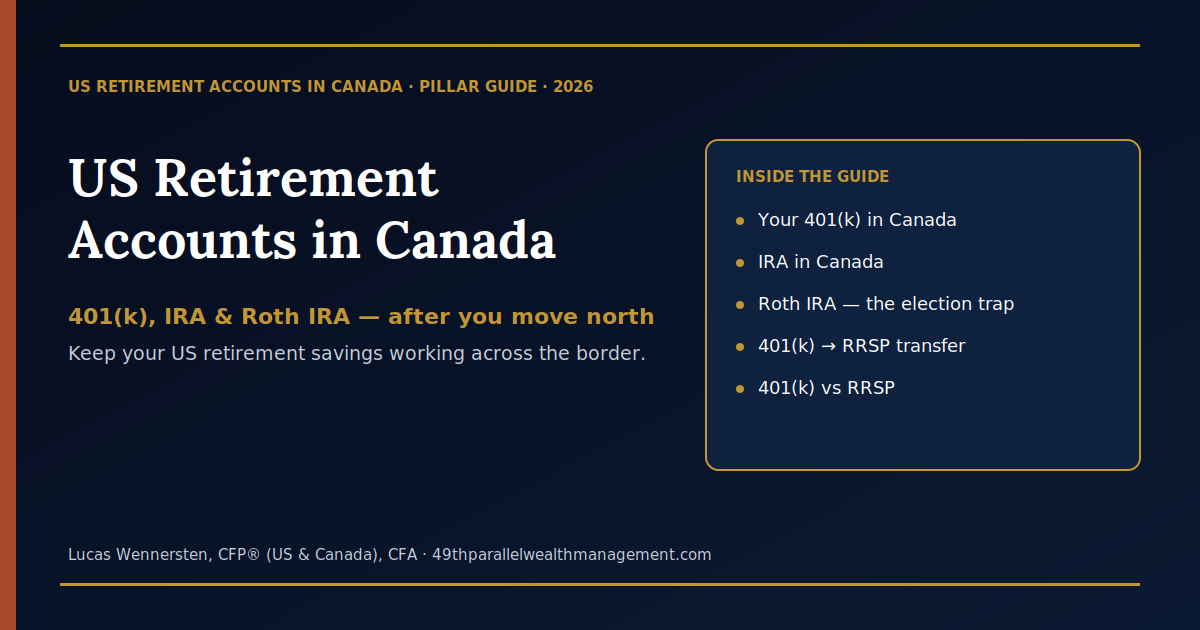
This guide is the map of the whole landscape — what happens to each account type, the one election that keeps a Roth tax-free in Canada, when (and whether) to move money into an RRSP, and the withdrawal rules that catch cross-border retirees off guard. Each section links to the in-depth piece on that topic.
The big picture: the treaty does the heavy lifting
Three facts shape every outcome below.
First, the treaty recognizes your accounts as pensions. Under Article XVIII of the Canada–US tax treaty, a 401(k) and a traditional IRA are treated as pension plans. That means Canada does not tax the growth inside them year to year — the deferral that existed while you lived in the US continues after you become a Canadian resident. Canada taxes the money only when you withdraw it.
Second, what you do at the moment of becoming a Canadian tax resident matters more than anything else. Some accounts (notably the Roth) require a one-time election filed with the Canada Revenue Agency to preserve their treatment. Miss the step, or keep contributing after you’ve moved, and you can permanently lose the benefit. Residency timing is its own subject — if you’re unsure when your Canadian residency actually starts, that determination drives everything else.
Third, “deferral” is not “tax-free” for traditional accounts. A 401(k) or traditional IRA is taxed on withdrawal — by the US first, then by Canada, with a foreign tax credit to prevent true double taxation. The Roth is the exception, and only if you handle it correctly.
With that frame, here’s each account.
Your 401(k) after moving to Canada
For most people, the right answer is the simplest one: leave the 401(k) where it is, or roll it into an IRA for more investment flexibility, and let it keep growing tax-deferred. You do not have to move it to Canada, and you usually shouldn’t rush to. The full mechanics — rollovers, choosing a cross-border-friendly custodian, and the withholding math — are covered in what happens to your 401(k) when you move to Canada. The essentials:
- Deferral continues. Canada won’t tax the internal growth. You report withdrawals as income in the year you take them.
- Withdrawals are taxed on both sides, then reconciled. The US applies withholding — generally 15% on periodic pension payments under the treaty, but up to 30% on a lump-sum distribution that doesn’t qualify as periodic. Canada then taxes the same withdrawal as income and grants a foreign tax credit for the US tax paid, so you’re not taxed twice on the same dollars.
- The early-withdrawal penalty is the trap. If you take money out before age 59½, the US adds a 10% penalty on top of regular tax. That penalty is not creditable in Canada — there’s no Canadian tax to credit it against. This is exactly why “cash it out and move on” is so costly.
- A US custodian may not want a Canadian-resident account holder. Many US brokerages restrict accounts once you have a Canadian address. Sorting out a cross-border-capable custodian before you move avoids a forced, badly timed distribution.
IRAs in Canada
A traditional IRA gets the same treaty pension treatment as a 401(k): deferral continues, withdrawals are taxed and credited the same way. A few IRA-specific points are worth knowing, and the full detail lives in IRA in Canada:
- You generally can’t keep contributing once you’ve stopped having US earned income — IRA contributions require compensation reportable to the US.
- Non-resident withholding and beneficiaries are their own puzzle. If you inherit a US IRA while living in Canada, or you name Canadian-resident beneficiaries on your own IRA, the withholding and reporting can get complicated quickly.
- An IRA is not an RRSP. They rhyme conceptually, but the contribution rules, withdrawal rules, and cross-border treatment differ — which is the whole point of the comparison further down.
The Roth IRA — a prize and a trap in the same account
This is the account people get wrong most often, and the one with the most at stake. Handled correctly, a Roth IRA stays completely tax-free in Canada — Canada will honor its tax-free character. Handled carelessly, you can taint it and turn a tax-free account into a taxable one. The complete walkthrough is in your Roth IRA after moving to Canada; here is the rule in plain terms.
Step one: file the one-time treaty election. Under the treaty and the related competent-authority guidance, a Canadian resident can make a one-time election to defer Canadian taxation on a Roth IRA, preserving its tax-free growth. This election is filed with the CRA, and it generally needs to be made for the year you become a Canadian resident. Done right, the Roth keeps growing with no Canadian tax — mirroring how it works in the US.
Step two — and this is the trap: stop contributing. The election protects the balance and growth as of the date you became a Canadian resident. The moment you (or your employer, or anyone) make a Canadian contribution — any contribution to the Roth after you became a resident of Canada — that portion is treated as a separate, taxable account in Canada, and the earnings on it become taxable. One well-intentioned contribution can compromise the account’s clean status. The discipline is simple: make the election, then never add another dollar while you’re a Canadian resident.
For anyone with a meaningful Roth balance, getting both steps right is often worth far more than any other single cross-border move.
Should you transfer a 401(k) or IRA to an RRSP?
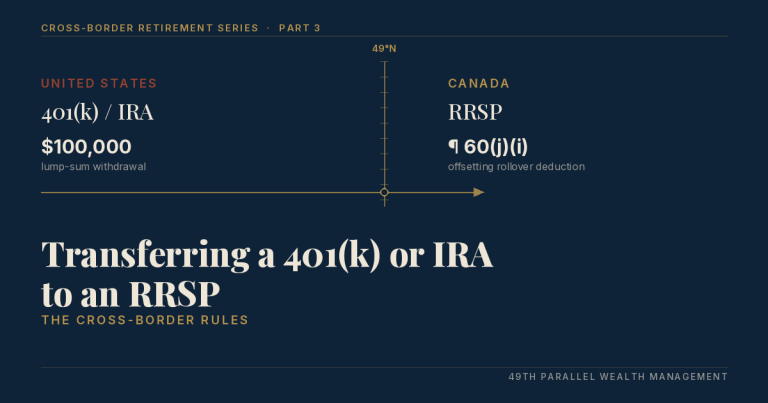
It sounds tidy — consolidate your US accounts into your Canadian RRSP and deal with one system. It is also, for most people under age 59½, a costly idea. The full analysis is in transferring a 401(k) or IRA to an RRSP. The short version:
- There is a mechanism. A lump-sum from a 401(k) or IRA can be contributed to an RRSP using a special rule (paragraph 60(j) of the Income Tax Act) that creates extra RRSP room for the transfer, so it doesn’t consume your regular contribution room. On the Canadian side, you bring the withdrawal into income and deduct the RRSP contribution — roughly a wash.
- The US side is where it breaks down. The withdrawal is a taxable US distribution. The US withholds tax, and if you’re under 59½, the 10% penalty applies — and neither the penalty nor any timing mismatch is fully solved by the Canadian foreign tax credit. You often have to fund the US tax out of pocket, and you may not recover all of it.
- When it can make sense: you’re over 59½ (no penalty), you can manage the US withholding, and you have a specific reason to consolidate. For most people, the better default is to leave the accounts in the US under treaty deferral.
401(k) vs RRSP, at a glance
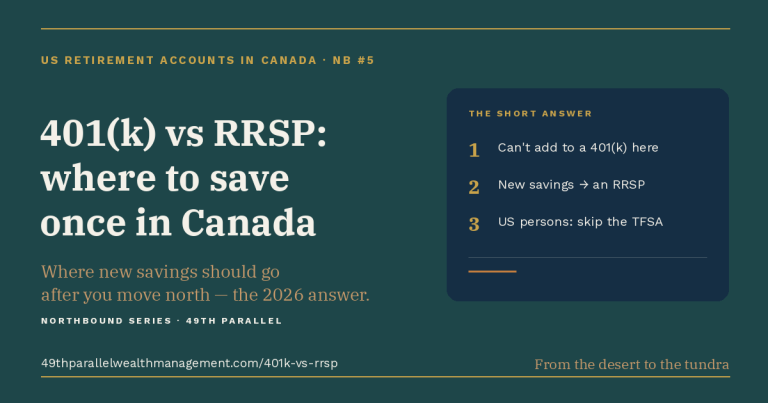
If you’re choosing where to direct new retirement savings once you’re settled in Canada, the systems differ in ways that matter. The full side-by-side is in 401(k) vs RRSP:
- Contributions: RRSP room is a percentage of earned income up to an annual dollar cap; 401(k) limits are set in fixed dollar amounts and often include an employer match — which an RRSP-via-group-plan may or may not mirror.
- Withdrawals and forced timing: A US 401(k)/IRA is subject to Required Minimum Distributions starting at age 73. An RRSP must be converted to a RRIF (or annuity) by the end of the year you turn 71, after which minimum withdrawals begin. Cross-border retirees can end up juggling both.
- Tax character: Both are tax-deferred going in and taxable coming out — the difference is which country taxes first and how the credit flows.
The withdrawal clocks that catch people
Two timing rules deserve their own flag because they operate independently:
- US RMDs at 73. Living in Canada does not exempt a US citizen (or a non-resident with US accounts subject to the rule) from US required minimum distributions. The US still expects them.
- The RRIF conversion at 71. Any RRSP — including one you built by transferring US funds — must convert to a RRIF by age 71, starting mandatory withdrawals.
Coordinating these, with the treaty’s 15% withholding and the foreign tax credit, is the core of cross-border retirement-income planning. Which account to draw from first — Roth, IRA, RRSP, or TFSA — is its own decision, and we work through it in which account to spend first: your IRA or your RRSP.
If you’re a US citizen or green-card holder living in Canada
US citizens and green-card holders are taxed by the US on worldwide income no matter where they live — so moving to Canada doesn’t end your US filing obligations. Two things to keep in mind, both of which connect to other parts of our library:
- You still file US returns and information reports. That includes the foreign bank account report (FBAR) and, for many, Form 8938. Your US retirement accounts and your new Canadian accounts both feed into that picture.
- Your RRSP is handled automatically on the US side. Thanks to Rev. Proc. 2014-55, US persons no longer file the old Form 8891 to defer tax on an RRSP — the deferral is automatic. (Your TFSA and RESP, however, are not friendly accounts for US persons — they can create trust-reporting and PFIC headaches. That’s a separate topic, but worth raising with your advisor before you open one.)
Your order of operations when you move
A clean sequence prevents almost every expensive mistake:
- Before you leave the US: confirm your residency-change date, line up a cross-border-capable custodian for your 401(k)/IRA, and take stock of every account (including any Roth).
- The year you become a Canadian resident: file the Roth treaty election if you have a Roth; stop contributing to it; decide what stays in the US versus what (if anything) genuinely needs to move.
- Ongoing: report US-source withdrawals correctly on both returns, claim the foreign tax credit, and coordinate the RMD/RRIF clocks as you approach your 70s.
None of this requires liquidating anything. It requires doing a handful of things in the right order, on time.
Frequently asked questions
Do I have to move my 401(k) or IRA to Canada when I move?
No. In most cases you can leave it in the US, where it keeps growing tax-deferred. Under Article XVIII of the Canada–US treaty, Canada doesn’t tax the internal growth until you withdraw.
Will I be taxed twice when I withdraw from my 401(k)?
Not on the same dollars. The US taxes the withdrawal first (typically 15% withholding on periodic pension payments under the treaty), then Canada taxes it and grants a foreign tax credit for the US tax paid.
Can I keep my Roth IRA tax-free in Canada?
Yes, if you file the one-time election under Article XVIII(7) with the CRA for the year you become a resident and you stop contributing to the Roth once you’re a Canadian resident. Done correctly, Canada respects the Roth’s tax-free status.
When do I have to file the Roth treaty election?
By the filing due date of your personal (T1) tax return for the first year you become a Canadian resident. It is a one-time, irrevocable election. If you miss the deadline, contact the CRA’s Competent Authority Services Division, as a late or protective election may be considered.
What happens if I contribute to my Roth IRA after moving to Canada?
A contribution made while you’re a Canadian resident (a “Canadian Contribution”) splits the account: the balance before the contribution stays tax-free under the election, but the contribution and all growth after it become taxable in Canada. The rule of thumb is to never contribute to a Roth while resident in Canada.
Should I roll my 401(k) into an RRSP?
Usually not before age 59½. There is a mechanism (paragraph 60(j)) to contribute a lump sum to an RRSP without using your regular contribution room, but the US withdrawal triggers US tax and, under 59½, a 10% penalty the Canadian foreign tax credit can’t offset. For most people, leaving the account in the US under treaty deferral is better.
Can I transfer my 401(k) to an RRSP without paying tax?
It’s tax-neutral in Canada, not tax-free overall. You report the lump sum as income, deduct the RRSP contribution under paragraph 60(j) (which doesn’t use your regular room), and claim a foreign tax credit for US tax withheld. But US withholding and any 10% early-withdrawal penalty are real out-of-pocket costs. Roth IRAs don’t qualify for 60(j).
Do I still pay US RMDs if I live in Canada?
Generally yes. US required minimum distributions apply to US retirement accounts starting at age 73, regardless of where you live.
What is the Canadian equivalent of a 401(k)?
The closest equivalent is an RRSP (Registered Retirement Savings Plan), or an employer Group RRSP or defined-contribution pension. All are tax-deferred, but contribution rules, employer matching, and withdrawal timing differ.
I’m a US citizen living in Canada — do I still file US taxes?
Yes. The US taxes citizens and green-card holders on worldwide income, so you keep filing US returns and information reports (FBAR, often Form 8938) in addition to your Canadian return. Your RRSP is automatically deferred on the US side under Rev. Proc. 2014-55.
What is the most expensive mistake people make?
Cashing out a 401(k) or IRA before age 59½ when they move. That triggers US income tax plus a 10% early-withdrawal penalty the Canadian foreign tax credit can’t recover.
Is an RRSP the same as an IRA?
No. Both are tax-deferred retirement accounts, but contribution rules, withdrawal rules, and cross-border treatment differ — which is why a 401(k)/IRA and an RRSP are handled separately when you move.
This article is general information for educational purposes, not personalized tax, legal, or investment advice. Cross-border rules and treaty interpretations are detail-sensitive and change over time; figures such as contribution limits and withholding can vary year to year. Before acting, speak with a cross-border advisor qualified in both countries. 49th Parallel Wealth Management’s planning is led by a CFP® professional licensed in the US and Canada.
Ready to map your own accounts? Book a cross-border retirement review, or learn more about our cross-border retirement planning.