Visa & Citizenship Paths: The US-Canada Immigration Guide
By Lucas Wennersten, CFP® (US & Canada), CFA · 9 minute read · Updated May 14, 2026
Moving across the Canada-US border is one of the most common life events our practice sees. A Canadian engineer accepts a job in Austin. An American physician takes a position in Vancouver. A retired US couple decides to spend their winters in BC. A Canadian family follows a child to the US for college and stays. Each scenario triggers a different immigration pathway, with different visa categories, residency timelines, and routes to eventual citizenship.
This guide covers the actual pathways that matter for Canada-US moves: which US visa to use, which Canadian permanent-residency program applies, and how naturalization works in each direction. It’s the practical overview, not a comprehensive immigration law treatise — your specific case should be reviewed by a cross-border immigration attorney. But after reading this, you’ll know which path applies to your situation, which forms come into play, and what timeline to expect.
Canadians Moving to the United States
Canada and the United States share a unique immigration relationship. The 1988 Canada-US Free Trade Agreement, now the United States-Mexico-Canada Agreement (USMCA), creates a streamlined work-visa category specifically for Canadian and Mexican professionals. On top of that, every other US work-visa category — H-1B, L-1, O-1, E-2 — is available to Canadians the same way it’s available to any foreign professional. The result: Canadians have more US work-visa options than nationals of almost any other country.
The trade-off is that work visas don’t equal permanent residency. A TN visa is renewable indefinitely but it’s still a ‘nonimmigrant’ visa — you must show intent to return to Canada when it expires. To stay permanently, you need a Green Card, which involves a separate (and longer) process.
TN Visa — The Workhorse for Professional Canadians
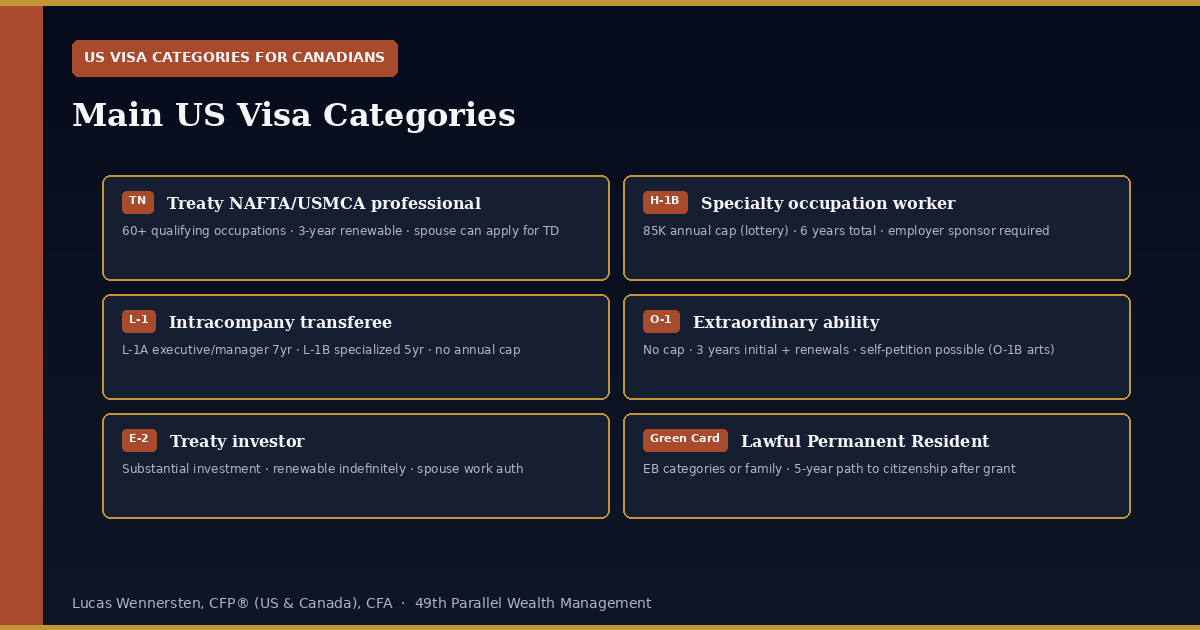
The TN visa under USMCA is the single most-used US work category for Canadians. It covers 60+ qualifying occupations including engineers, accountants, scientists, lawyers, management consultants, computer systems analysts, and several medical professionals. The requirements are: a job offer in a qualifying occupation, a US employer willing to provide a support letter, and (in most cases) a bachelor’s degree in a relevant field.
TN visas are issued for up to 3 years and renewable indefinitely. Canadian citizens apply at the border (or at a preflight inspection at major Canadian airports) — no consular interview required. Mexican citizens face a more involved consular process. Spouses can accompany you on a TD visa, but cannot work without separate authorization.
TN’s main limitation is that it’s a strict ‘nonimmigrant’ visa. Showing any intent to immigrate during a TN renewal can lead to denial. If you’re using TN as a stepping stone to a Green Card, work with an immigration attorney to time the transition carefully.
H-1B — Specialty Occupation
The H-1B visa is for specialty occupation workers — typically positions requiring a bachelor’s degree or higher in a specific field. It’s subject to an annual cap of 85,000 visas (65,000 regular + 20,000 US master’s degree exemption), allocated through a lottery each March. Selection rates have dropped to roughly 25% in recent years.
H-1B is a dual-intent visa, meaning you can pursue a Green Card while holding it — a significant advantage over TN. Maximum stay is 6 years (3 years initial + 3 year renewal), extendable if a Green Card application is in process. The employer files the petition; you cannot self-sponsor.
For Canadians qualifying for TN, the question is whether to accept TN’s renewable-indefinitely simplicity or pursue H-1B’s path to permanent residency. Most cross-border tech workers we see start on TN and transition to H-1B or directly to a Green Card category once the employer-sponsorship process matures.
L-1 Intracompany Transferee
If you’ve worked for at least one year out of the past three at a company with a US affiliate, you may qualify for an L-1 visa. L-1A is for executives and managers (up to 7 years total); L-1B is for specialized-knowledge workers (up to 5 years total). Like H-1B, L-1 is dual-intent and can lead to a Green Card. There’s no annual cap.
L-1 is the standard path when a Canadian company opens a US office, or when a multinational moves a Canadian employee to a US subsidiary. It’s also the basis for many family business cross-border expansions.
O-1 Extraordinary Ability
The O-1 visa applies to people with documented extraordinary ability in sciences, education, business, athletics (O-1A), or arts/entertainment (O-1B). It’s a high bar — published research, major awards, significant media coverage, or comparable evidence is required. No annual cap, dual-intent, and renewable in 3-year increments.
O-1 is the right path for senior professionals whose accomplishments meet the threshold, founders of companies with recognized track records, and high-profile professionals in fields where the bar is achievable.
E-2 Treaty Investor
Canada-US Treaty Investor visas let Canadian citizens invest substantial capital in a US business they will direct and operate. There’s no fixed minimum investment, but the investment must be substantial relative to the business’s total value and sufficient to ensure the enterprise’s successful operation — practically, this usually means at least $100,000-$200,000 USD for small businesses. E-2 is renewable indefinitely as long as the business is operating; spouses can apply for work authorization.
E-2 is the right path for entrepreneurs and family-business owners. It does NOT lead directly to a Green Card — separate immigrant petition required for that.
Green Card — Lawful Permanent Resident
Lawful Permanent Resident status (Green Card) is the gateway to US citizenship. Common paths for Canadians:
- Employment-based (EB) categories: EB-1 (extraordinary ability/executives), EB-2 (advanced degree/exceptional ability — most common for skilled professionals), EB-3 (skilled workers). The employer typically initiates with a PERM labor certification, followed by Form I-140 immigrant petition.
- Family-based: Spouse, parent, or unmarried child of a US citizen. Spousal petitions (Form I-130) are the most common Canadian path and typically take 12-18 months from filing to Green Card.
- EB-5 Investor: Minimum investment of $1,050,000 (or $800,000 in a Targeted Employment Area) plus creation of 10 US jobs. Faster Green Card path but capital-intensive.
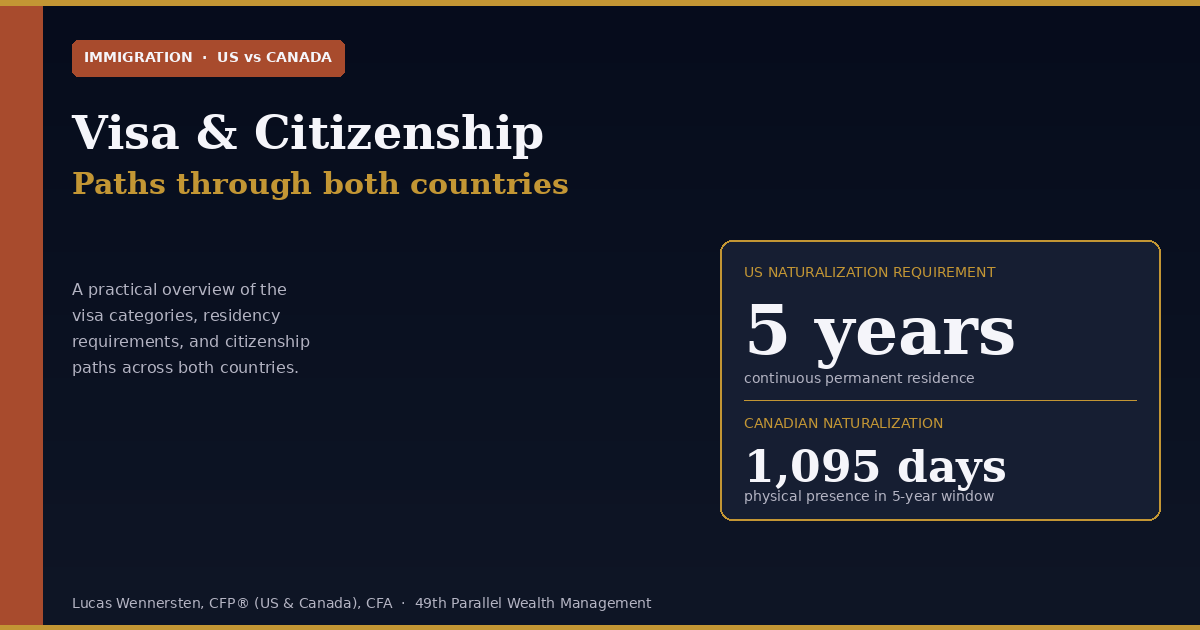
Green Card holders can apply for US citizenship after 5 years of continuous permanent residence (3 years if obtained through marriage to a US citizen). More on naturalization below.
Americans Moving to Canada

Canada’s immigration system is structured around permanent residency from the start — there’s no equivalent to the US’s long-term renewable nonimmigrant visa categories. Most Americans moving to Canada either obtain a work permit (temporary, tied to a specific employer) and transition to permanent residency, or apply for permanent residency directly from outside the country.
The main Canadian PR programs:
Express Entry — The Federal Points System
Express Entry is Canada’s federal points-based selection system covering three programs: Federal Skilled Worker (FSW), Canadian Experience Class (CEC), and Federal Skilled Trades (FST). Applicants enter a candidate pool, receive a Comprehensive Ranking System (CRS) score based on age, education, language proficiency, work experience, and other factors, and the highest-scoring candidates are invited to apply in regular draws.
Since 2023, the system has used category-based draws to prioritize specific occupations and language profiles, including healthcare workers, trades workers, STEM professionals, transport sector workers, agriculture/agri-food workers, and French-language speakers. Category-based draws often have lower CRS cutoff scores than general draws, making them an important strategy for borderline applicants.
For typical American applicants — well-educated, English-speaking, with relevant work experience — CRS scores in the 450-500 range are common, and Invitations to Apply are issued from roughly that threshold (varies by draw). After invitation, the application package takes 6 months on average to process.
Provincial Nominee Programs (PNP)
Each Canadian province operates its own Provincial Nominee Program targeting specific labor needs. Provincial nomination adds 600 points to your Express Entry CRS score — effectively guaranteeing selection in the next general draw. Many provinces also run their own standalone (non-Express Entry) streams.
PNP is the right path when your skills or work history align with a specific province’s needs. Ontario, BC, and Alberta have the largest programs but also the most competition. Smaller provinces (Saskatchewan, Manitoba, Atlantic provinces) often have lower thresholds and more straightforward pathways for skilled workers.
Family Sponsorship
Canadian citizens and permanent residents can sponsor spouses, common-law partners, dependent children, and (in some cases) parents and grandparents. Spousal sponsorship is the most common American-to-Canadian path: an American married to a Canadian can apply for PR with the Canadian spouse as sponsor.
Spousal sponsorship from inside Canada (inland) typically takes 10-12 months. From outside Canada (outland) is similar. Income requirements apply for the sponsor, and the relationship must be genuine and ongoing. Common-law partners (12+ months of cohabitation) are eligible on the same basis as married spouses.
Start-Up Visa Program
Canada’s Start-Up Visa program offers PR to entrepreneurs whose business has been endorsed by a designated Canadian venture capital fund, angel investor group, or business incubator. The endorsement requirements are substantial — designated investors and incubators have a high bar — but successful applicants receive PR within 12-18 months.
This is the right path for founders building businesses with real Canadian market potential, not as an easier alternative to other PR paths.
Naturalization: The Path to Citizenship
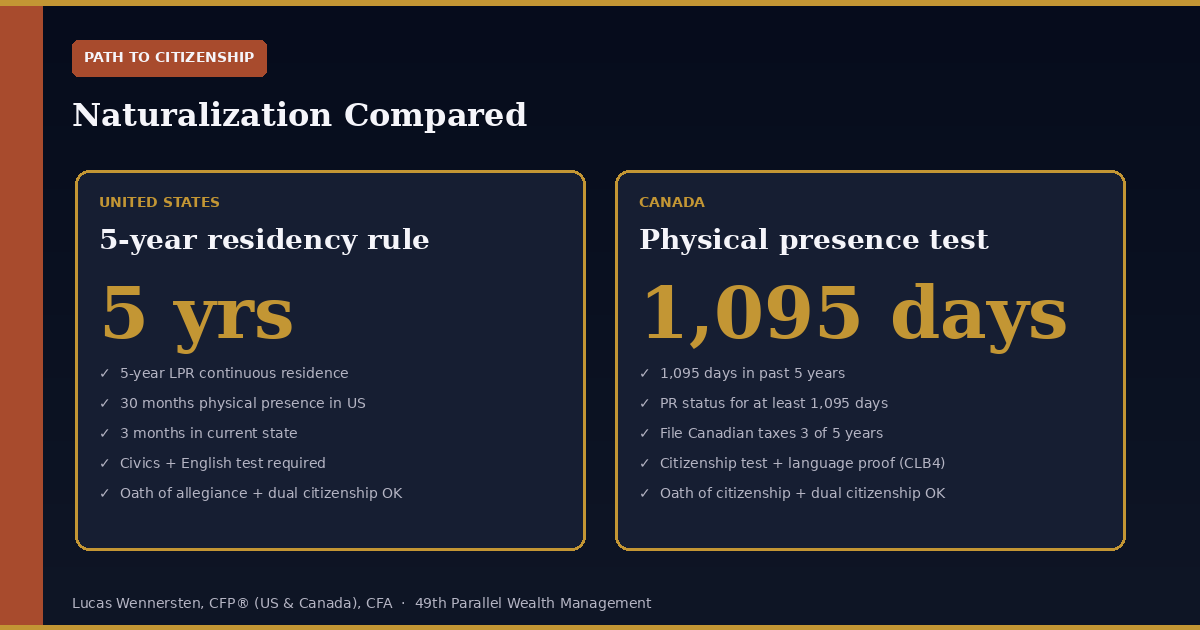
US Naturalization for Canadian Green Card Holders
US naturalization is administered by USCIS and requires:
- 5 years as a Lawful Permanent Resident: (3 years if Green Card obtained through marriage to a US citizen, with the marriage ongoing)
- Continuous residence in the US for 5 years immediately before filing: and physical presence in the US for at least half that time (30 of the 60 months)
- 3 months of residence in the state where you file
- Good moral character: demonstrated by tax compliance, no significant criminal history, no prior immigration violations
- Civics test: 10 questions from a pool of 100 — must answer 6 correctly
- English proficiency: (speaking, reading, writing — assessed during the naturalization interview)
- Oath of Allegiance: to the United States
The US recognizes dual citizenship by default — naturalized US citizens can keep their Canadian citizenship. However, the proposed Exclusive Citizenship Act of 2025, if enacted, would change this — see the US vs Canada citizenship law comparison for the implications.
Canadian Naturalization for American Permanent Residents
Canadian citizenship is administered by Immigration, Refugees and Citizenship Canada (IRCC) and requires:
- Permanent Resident status: for at least the 1,095 days of physical presence below
- 1,095 days of physical presence in Canada: during the 5 years immediately before applying (under Bill C-6, time spent in Canada as a temporary resident before PR can count partially)
- Filed Canadian taxes: for at least 3 of the 5 years
- Demonstrated language ability in English or French: (Canadian Language Benchmark Level 4 or higher — speaking and listening tested)
- Citizenship test: 20 questions about Canadian history, values, government, geography — must answer 15 correctly (75%)
- Oath of Citizenship: to Canada and the King
Canada recognizes dual citizenship by default — naturalized Canadian citizens can keep their US citizenship. Bill C-3 (covered in our US-Canada citizenship law comparison) expands Canadian citizenship rights further, including restoring citizenship to people who lost it under earlier rules and broadening citizenship-by-descent.
How Immigration Status Affects Cross-Border Tax
Immigration status and tax residency are related but not identical. Tax residency is determined by the substantial presence test in the US and the deemed-residency rules in Canada, both of which can apply regardless of your immigration status.
Three high-level rules:
First, US citizens and Green Card holders are taxed by the IRS on worldwide income regardless of where they live. This is citizenship-based taxation, and it persists even after leaving the United States permanently. Renunciation has tax consequences — see our deep analysis of the Exclusive Citizenship Act for the mechanics.
Second, Canadian residents are taxed by the CRA on worldwide income, but only while they remain Canadian tax residents. Leaving Canada triggers a deemed disposition — essentially a deemed sale of your worldwide assets — with capital gains tax owed before departure.
Third, the Canada-US Tax Convention allocates taxing rights and provides foreign tax credit mechanics, but doesn’t eliminate the filing obligations. A Canadian on a TN visa in the US generally becomes a US tax resident under the substantial presence test, files a US 1040, and may or may not still be a Canadian tax resident — the determination is fact-specific and matters substantially for retirement account treatment, RRSP/IRA contribution eligibility, and ongoing reporting obligations.
The Bottom Line
Canada and the US have more cross-border immigration options between them than almost any other country pair. The TN visa is unique to North America. Express Entry is one of the more accessible permanent-residency systems among developed economies. Both countries recognize dual citizenship by default. Family sponsorship works in both directions. The infrastructure for moving in either direction is mature.
What complicates the picture isn’t immigration law on its own — it’s the tax consequences that travel alongside. The right visa or PR program for your situation depends on more than the immigration question: where do you want your assets to live, how much foreign income reporting are you prepared to handle, what’s your long-term plan for citizenship and dual status? Coordinated cross-border financial planning answers these questions in parallel with the immigration decision.
Frequently Asked Questions
Q: What is the TN visa and who qualifies?
A: The TN visa is a US work-visa category created under USMCA (formerly NAFTA) for Canadian and Mexican professionals. It covers 60+ qualifying occupations including engineers, accountants, scientists, lawyers, management consultants, and several medical and education professions. Requirements: a job offer from a US employer in a qualifying occupation, a support letter, and (in most cases) a bachelor’s degree in a relevant field. Canadians apply at the border or at a preflight inspection.
Q: How long does it take to get a US Green Card as a Canadian?
A: It depends on the path. Spousal Green Card (marriage to a US citizen): typically 12-18 months from petition filing. Employment-based EB-2: roughly 18-36 months for Canadians, including PERM labor certification and the I-140 petition. EB-5 investor: 2-3 years. Family-based for siblings of US citizens: can be 10+ years due to category backlogs. Talk to an immigration attorney about which path fits your situation.
Q: Can I work in the US on a tourist visa or visa waiver?
A: No. Tourist visas (B-1/B-2) and the Visa Waiver Program permit business travel but not employment. Working without proper authorization is grounds for visa revocation, future visa denial, and bars from re-entry. Always obtain proper work authorization (TN, H-1B, L-1, etc.) before accepting US employment.
Q: What is Canada’s Express Entry CRS score and what threshold do I need?
A: The Comprehensive Ranking System (CRS) scores candidates on age, education, language proficiency (English or French), work experience, adaptability factors (spouse education, Canadian work experience), and arranged employment. Out of 1,200 possible points, recent general draws have had cutoff scores in the 480-540 range. Category-based draws (healthcare, trades, STEM, French speakers) often have lower cutoffs. Most American applicants with bachelor’s degrees, professional work experience, and strong English score in the 450-520 range.
Q: Does provincial nomination guarantee Canadian permanent residency?
A: Effectively yes, under Express Entry. A provincial nomination adds 600 points to your CRS score, which puts you above any realistic cutoff and triggers an Invitation to Apply (ITA) in the next general draw. After ITA you submit a full application package and IRCC processes it (typically 6 months). The nomination itself is the harder part — provinces have specific labor needs and require ties to the province.
Q: How long must I wait to apply for US citizenship after getting a Green Card?
A: 5 years for most Green Card holders (continuous residence as a permanent resident). 3 years if you got your Green Card through marriage to a US citizen AND the marriage is still ongoing at the time of naturalization. You also need to have been physically present in the US for at least half of those years (30 of 60 months for 5-year rule, 18 of 36 months for 3-year rule).
Q: How long must I wait to apply for Canadian citizenship after becoming a permanent resident?
A: You need 1,095 days of physical presence in Canada during the 5 years immediately before applying. Under Bill C-6 (2017), time spent in Canada as a temporary resident before PR can count partially toward this — each day as a temp resident counts as a half-day, up to 365 days. So if you lived in Canada for 2 years on a work permit before becoming PR, you can count 365 days of that toward your physical presence requirement.
Q: Can I keep my US citizenship if I become Canadian, or vice versa?
A: Both countries recognize dual citizenship by default. Becoming a Canadian citizen does not require you to renounce US citizenship, and becoming a US citizen does not require you to renounce Canadian citizenship. The proposed Exclusive Citizenship Act of 2025 in the US would change this if enacted — see our analysis of the Act for details.
Q: If I’m on a TN visa, am I a US tax resident?
A: Generally yes, under the substantial presence test. The IRS treats anyone present in the US for 183+ days in a year (or 183 weighted days over 3 years) as a US tax resident, regardless of visa status. TN visa holders typically meet this and file Form 1040 as residents. Special rules apply for first and last year of presence — work with a cross-border tax preparer in your first year of US residency.
Q: Does becoming a US permanent resident affect my Canadian retirement accounts?
A: Yes, and the rules are nuanced. Your RRSP is generally protected from current US tax under the Canada-US Tax Treaty (Article XVIII) — growth remains tax-deferred until withdrawal. However, you’ll need to disclose it on FBAR (FinCEN Form 114) and Form 8938 each year. TFSAs are NOT recognized by the IRS and are problematic for US persons. RESPs trigger US trust reporting (Forms 3520/3520-A). Coordinate with a cross-border financial planner before moving — these decisions are easier to get right BEFORE you become a US resident than after.
Cross-Border Planning Starts Before You Move
The right immigration path is rarely independent of your financial picture. RRSP and 401(k) treatment, tax residency timing, retirement account elections, real estate ownership structure — all change when you cross the border, and the planning often needs to happen BEFORE the move, not after. If you’re contemplating a Canada-US move, book a complimentary consultation with 49th Parallel Wealth Management. Lucas Wennersten is dual-licensed CFP® in both the US and Canada and a CFA — our entire practice is built around the families moving in both directions.
This article is for general educational purposes and is not legal, tax, immigration, or investment advice. Immigration rules change frequently. Annual caps, qualifying occupations, fee structures, and processing times all shift. Confirm current requirements with USCIS, IRCC, or a qualified immigration attorney before making decisions. For tax and financial planning aspects of cross-border moves, consult a cross-border financial planner.