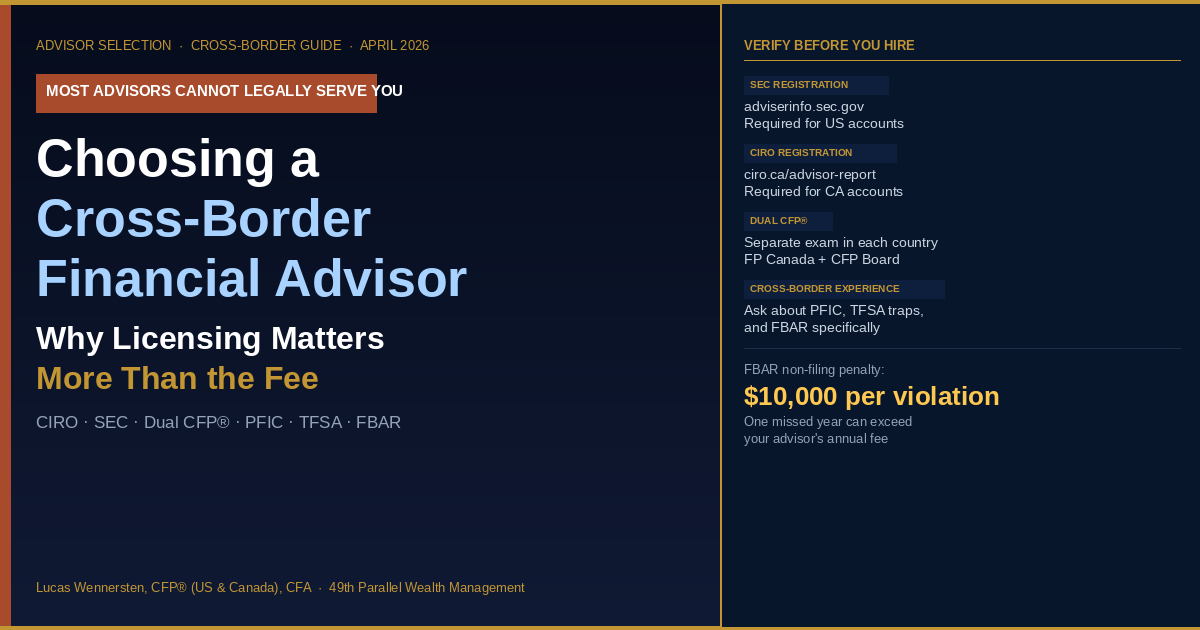
How to Choose a Cross-Border Financial Advisor: Why Licensing Matters More Than the Fee
If you have financial accounts, pension assets, or property in both Canada and the United States, the first question to ask when evaluating a financial advisor is not what they charge. It is whether they are legally permitted to advise you on both sides of the border at all.
Most financial advisors; whether based in Canada or the US, are licensed in one country only. A Canadian advisor regulated by CIRO (the Canadian Investment Regulatory Organization) is generally not registered with the SEC or state regulators in the US, which means they cannot legally manage or advise on your US brokerage accounts, IRA, or 401(k). A US-registered investment advisor who is not licensed under Canadian securities law cannot legally advise you on your RRSP, TFSA, or Canadian non-registered accounts.
This is not a technicality. It is the regulatory reality that defines the entire market for cross-border financial advice. Once you understand it, the conversation about fees, AUM structures, and advisor selection changes fundamentally.
The Licensing Problem: Who Can Actually Advise You?
Canada and the United States have entirely separate regulatory regimes for financial advisors. In Canada, investment advisors are regulated by CIRO (formerly IIROC) or by provincial securities commissions depending on the type of advice and accounts involved. In the US, investment advisors are registered either with the SEC (for larger advisors) or with state regulators, and must comply with the Investment Advisers Act of 1940.
THE CORE PROBLEM IN ONE PARAGRAPH A Canadian advisor who is not SEC-registered cannot legally provide investment advice on a US person’s US accounts. A US advisor who is not registered under Canadian securities law cannot legally manage a Canadian resident’s RRSP or provide ongoing investment advice in Canada. The pool of advisors who hold registrations in both countries — and who are actively licensed and compliant in both regulatory systems simultaneously — is very small. If an advisor claims to serve cross-border clients without being able to clearly explain their licensing on both sides, that is a serious regulatory red flag. |
The cross-border licensing requirement has practical consequences beyond regulatory compliance. An advisor who only holds Canadian registration may be able to provide general financial planning guidance to a US person, but cannot execute trades, provide specific investment advice on US accounts, or manage a US-held portfolio. An advisor who only holds US registration can manage US accounts but is in a legal grey area when advising a Canadian resident on Canadian accounts.
You can verify a US advisor’s registration at the SEC’s Investment Adviser Public Disclosure database: adviserinfo.sec.gov. For Canadian advisors, CIRO’s Advisor Report is at ciro.ca/advisor-report. Both searches are free and take under two minutes.
Why Dual Licensing Has Real Costs — and Why That Matters for Fees
Maintaining active registration and compliance in both the US and Canada is genuinely expensive. It involves maintaining a registered investment advisor status with the SEC or a state regulator, complying with Canadian securities law through CIRO or provincial registration, holding professional designations that are recognised in both countries (the CFP® designation requires separate examination and licensing bodies in Canada and the US), paying ongoing regulatory fees, completing continuing education requirements in both jurisdictions, and maintaining compliance infrastructure — record-keeping, disclosures, client agreements — that satisfies regulators on both sides.
This is not a complaint about operating costs. It is context for understanding fee structures. When a cross-border advisor charges a fee that appears slightly higher than a domestic-only competitor, part of that differential reflects the cost of being legally able to serve you at all. A domestic advisor who cannot hold your RRSP and your IRA in the same plan is not actually a competitor — they can only serve part of your situation.
THE CFP® DESIGNATION ACROSS THE BORDER The CFP® (Certified Financial Planner) designation is independently administered in Canada and the United States by different organizations: • Canada: FP Canada administers the CFP® designation and requires separate Canadian examination, supervised experience, and annual continuing education under Canadian standards. • United States: The CFP Board administers the US CFP® designation with its own examination, ethics requirements, and continuing education standards. Holding both designations means passing both examinations, meeting both sets of experience requirements, and maintaining both sets of ongoing education requirements. Advisors who hold dual CFP® designations have demonstrated commitment to professional standards in both countries — and the right to use the marks in both. |
AUM Fees and Conflicts of Interest: The Standard Analysis
Once you have confirmed that an advisor is licensed to serve you on both sides of the border, the fee structure conversation that the original version of this post addressed becomes relevant. It is worth covering clearly.
Under an assets under management (AUM) fee model, an advisor charges an annual percentage of the total portfolio value they manage. A typical range for a full-service wealth management relationship is 0.75% to 1.5% depending on portfolio size, complexity, and the scope of planning services included. The fee aligns the advisor’s income with portfolio growth — when your assets grow, their fee grows too.
The genuine conflict in the AUM model is straightforward: the advisor’s incentive is to keep assets under their management rather than recommend actions that would reduce the balance. Paying down debt, making a large purchase, or moving assets to a different account type — even if those actions are in the client’s best interest — all reduce the AUM fee base. A client-centred advisor recognises this conflict and manages it through transparency and documented advice rationale. An advisor who avoids discussing it is a concern.
The long-term cost of fees is real and worth understanding concretely. On a $1,000,000 portfolio over 30 years, the difference between a 1.0% and a 0.75% AUM fee — holding returns constant — is over $180,000 in fees paid. At a 1.5% vs 1.0% differential, the difference exceeds $450,000. These are not trivial numbers, and fee compression over time through portfolio growth milestones (lower percentage tiers as assets increase) is worth negotiating explicitly.
The Cross-Border Fee Question No One Asks: What Currency?
Here is a fee structure question that arises only for cross-border clients and that almost no advisor addresses proactively: if you have a mixed CAD/USD portfolio and your advisor charges 1% AUM, in which currency is the fee calculated? Against which exchange rate? Who bears the currency conversion cost?
Scenario | If fee is calculated in USD | If fee is calculated in CAD |
CAD strengthens vs USD | Your fee in CAD-equivalent terms rises even if your USD portfolio is flat | USD portion of portfolio is worth less CAD — fee base shrinks relative to total wealth |
USD strengthens vs CAD | USD portfolio grows in USD terms and generates more USD fee income for advisor | CAD-equivalent of USD assets rises — fee base and fee income both increase |
Fee charged in client’s ‘home’ currency only | Currency conversion at what rate? Spot? Mid-market? Bank rate? Who pays the spread? | Same question — the mechanics of cross-currency billing should be in your client agreement |
These questions have no universally correct answer, but they have a correct process: ask them explicitly before signing a client agreement, and ensure the answers are documented. A cross-border advisor who has not thought through this billing question is likely not experienced in cross-border practice.
Competence Is Worth More Than a Fee Discount
The most important cross-border advisor selection criterion is not fees. It is the ability to avoid catastrophically expensive mistakes that a competent cross-border advisor prevents and a domestic-only advisor will not recognize.
Consider three examples of mistakes that a domestic-only advisor — regardless of their fee level — is structurally likely to miss:
- PFIC exposure on Canadian mutual funds: A US person holding Canadian mutual funds faces Passive Foreign Investment Company (PFIC) tax treatment under IRS rules — one of the most punitive tax regimes in the US tax code. PFIC excess distributions are taxed at the highest ordinary income rate plus an interest charge. A domestic US advisor placing Canadian funds in a cross-border client’s account without flagging this can create a tax liability that dwarfs any fee savings from choosing a cheaper advisor.
- TFSA as a tax shelter for US persons: A Canadian advisor who recommends maximising TFSA contributions for a US person living in Canada is providing advice that creates a US tax problem. The IRS does not recognise the TFSA as tax-exempt. All TFSA growth is fully taxable in the US in the year earned. A domestic Canadian advisor may not know this, or may not consider it their responsibility to address.
- Missed FBAR or T1135 filing: A US person with Canadian financial accounts above $10,000 USD must file an FBAR annually. A Canadian resident with US accounts above $100,000 CAD must file T1135 with their Canadian return. Non-willful FBAR penalties start at $10,000 per violation. A domestic advisor on either side is unlikely to proactively identify both obligations. One missed year can cost more than the advisor’s entire annual fee.
These are not edge cases. They are the standard situations that cross-border families encounter, and they are the reason why cross-border financial planning requires a specialist. The fee differential between a cross-border specialist and a domestic advisor is almost always smaller than the cost of a single avoidable mistake.
What to Actually Evaluate When Choosing a Cross-Border Advisor
With the licensing and competence context established, here is a practical checklist for evaluating a cross-border financial advisor:
- Confirm dual registration: Ask the advisor to confirm their registration status in both countries. Verify independently at adviserinfo.sec.gov (US) and ciro.ca (Canada). Registration status should be current, not historical.
- Ask about dual CFP® designations: Holding the CFP® in both Canada (FP Canada) and the US (CFP Board) signals that the advisor has passed both countries’ examinations and maintains ongoing education in both regulatory environments.
- Ask how they handle PFIC, FBAR, and TFSA: If the advisor cannot answer clearly, or defers entirely to your tax accountant without any planning input on their end, they are likely not a genuine cross-border specialist. These issues appear in every cross-border financial plan.
- Understand the fee structure and currency mechanics: Ask how fees are calculated on a mixed-currency portfolio. Confirm whether fee tiers apply as assets grow. Get the fee schedule in writing as part of the client agreement.
- Assess service continuity: Confirm you will work directly with the advisor you are interviewing, not be reassigned to a junior team member after onboarding. In cross-border planning, relationship continuity matters — your advisor needs to understand the history of decisions made on both sides of your financial picture.
- Evaluate cross-border experience specifically: Ask how many cross-border clients they currently serve and what the most common issues they resolve are. A specialist will have specific, concrete answers. A generalist will give vague responses about “international experience.”
Our cross-border financial planning FAQs cover many of the specific planning questions that come up in the advisor selection process, including account types, reporting obligations, and treaty positions.
FREQUENTLY ASKED QUESTIONS
1. Can my current Canadian financial advisor manage my US investment accounts?
Generally no, unless they are also registered with the SEC or a US state regulator. Canadian advisors regulated by CIRO are licensed to advise on Canadian accounts and Canadian residents. Providing investment advice on a US person’s US brokerage account, IRA, or 401(k) requires US registration. You can verify any advisor’s US registration status at adviserinfo.sec.gov. If your Canadian advisor is not listed there, they are not able to legally advise on your US accounts.
2. Can my US financial advisor help me with my RRSP and TFSA?
Generally no, unless they are also registered under Canadian securities law. US advisors registered with the SEC or FINRA are licensed to advise US clients on US accounts. Providing ongoing investment advice to a Canadian resident on their RRSP, TFSA, or Canadian non-registered accounts requires Canadian registration. A US advisor can often discuss general planning concepts, but cannot legally manage or place trades in Canadian registered accounts without Canadian registration.
3. What is an AUM fee and how does it work?
An assets under management (AUM) fee is an annual charge calculated as a percentage of the total value of assets the advisor manages on your behalf. For example, a 1% AUM fee on a $500,000 portfolio is $5,000 per year. The fee is typically deducted directly from the portfolio quarterly. AUM fees align the advisor’s income with portfolio growth, but also create a structural incentive to keep assets under management rather than recommend actions that reduce the fee base. Transparent advisors acknowledge this conflict and document their advice rationale.
4. What is a PFIC and why does it matter for cross-border investors?
PFIC stands for Passive Foreign Investment Company. Under IRS rules, most foreign mutual funds, ETFs listed on non-US exchanges, and many other foreign pooled investment vehicles qualify as PFICs for US tax purposes. PFIC excess distributions and dispositions are subject to a punitive tax treatment: taxed at the highest ordinary income rate plus an interest charge calculated back to the year the PFIC was acquired. A US person holding Canadian mutual funds, Canadian ETFs, or other Canadian pooled investments needs to address PFIC rules — ideally by holding the non-PFIC equivalent (individual stocks or US-listed ETFs) or by making a QEF election. This is one of the most commonly missed cross-border tax issues.
5. What is the difference between the CFP® designation in Canada and the US?
The CFP® designation is independently administered in each country. In Canada, FP Canada (formerly the FPSC) oversees the designation, including its own examination, supervised experience requirement, and continuing education standards. In the US, the CFP Board administers the designation with a separate examination, separate ethics requirements, and separate ongoing education. An advisor holding the CFP® in one country is not automatically recognised in the other. Advisors who have earned both designations have passed both examinations and meet both sets of ongoing standards.
6. How do I verify that a financial advisor is registered in both Canada and the US?
For US registration, search the SEC’s Investment Adviser Public Disclosure database at adviserinfo.sec.gov — enter the advisor’s name or firm name and confirm the registration is current and active. For Canadian registration, use CIRO’s Advisor Report at ciro.ca. Both searches are free. An advisor serving cross-border clients should appear in both databases, or be able to explain their provincial or state exemption clearly.
7. What is the TFSA trap for US persons?
The Tax-Free Savings Account (TFSA) is a Canadian registered account where investment gains are completely sheltered from Canadian income tax. However, the IRS does not recognise the TFSA as a tax-exempt account. For US persons — US citizens, green card holders, or US tax residents — all income and gains inside a TFSA are fully taxable in the United States in the year earned, with no offsetting Canadian tax credit. A US person maximising TFSA contributions with high-growth or volatile investments is unknowingly creating a US tax liability that their Canadian advisor may not flag.
8. What is FBAR and who has to file it?
FBAR (FinCEN Form 114) requires US persons to report any foreign financial account — bank account, brokerage account, RRSP, TFSA, or other registered account — in which they have a financial interest or signature authority if the aggregate value of all foreign accounts exceeds $10,000 USD at any point during the calendar year. The filing is separate from the federal income tax return and is due April 15 (with automatic extension to October 15). Non-willful failure to file carries penalties of up to $10,000 per violation. Willful failure carries much higher penalties.
9. How should fees on a mixed CAD/USD portfolio be structured?
There is no single standard, but the question should be addressed explicitly in your client agreement before you sign. Key issues to clarify: which currency is used to calculate the total AUM for fee purposes; what exchange rate is used and on what date; whether fee tiers apply to the combined total or to each currency separately; and who bears the cost of currency conversion if fees are paid in a different currency than the portfolio. A cross-border advisor who has not addressed these questions in their client agreements is likely newer to cross-border practice.
10. How do I know if a financial advisor genuinely specialises in cross-border planning?
Ask specific questions rather than accepting general claims. Ask them to explain what a PFIC is and how they handle it for clients with Canadian accounts. Ask how they manage TFSA planning for US persons. Ask how many current clients have accounts in both countries. Ask who else on their team has cross-border expertise. A genuine cross-border specialist will answer these questions with specifics, not generalities. An advisor with limited cross-border experience will often redirect to ‘working with your accountant’ without being able to describe their own role in cross-border planning.
READY TO WORK WITH AN ADVISOR WHO CAN SERVE BOTH SIDES?Most financial advisors can serve you in one country. Very few can legally serve you in both — and fewer still have the cross-border planning expertise to do it well. 49th Parallel Wealth Management was built specifically for clients who live and invest across the Canada-US border. Lucas Wennersten holds dual CFP® designations (US and Canada), the CFA credential, and is registered to advise clients on both sides of the border. Book a complimentary consultation — or explore our cross-border wealth management and cross-border investment management services. |